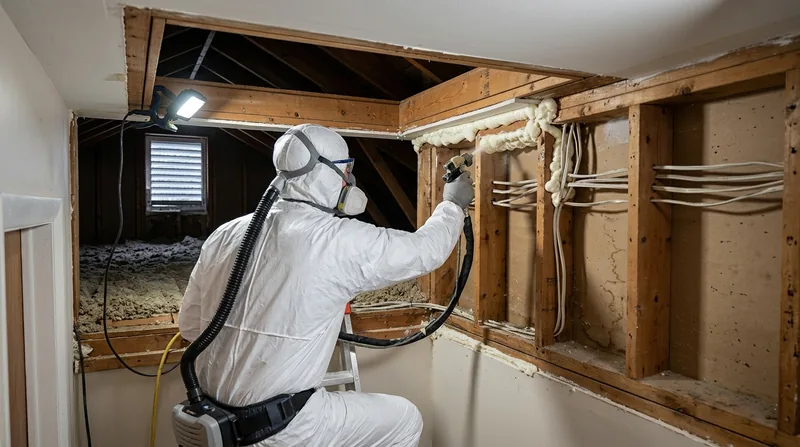




Air sealing in Syracuse stops warm indoor air from leaking into cold attics all winter, which is the root cause of ice dams on roofs across Onondaga County. In early-1900s balloon-frame houses in Eastwood, Westcott and Tipperary Hill, warm air rises through open wall cavities and unblocked penetrations, melting snow from below on subfreezing days. Mid-century capes and ranches in Liverpool, Camillus and DeWitt suffer the same stack effect: conditioned air escapes at the ceiling plane, carrying moisture into cold attic space where it condenses as frost or ice. When we seal the top plates, duct chases, electrical penetrations and the entire ceiling plane with closed-cell or open-cell foam, we slow that upward air movement and keep interior heat where it belongs. This is why air sealing is the single most effective energy retrofit for homes in climate zone 5A, and why it is the credibility test that separates a real insulation shop from a generic contractor. We have been sealing Syracuse attics since 2012, and we know exactly where the air leaks in your neighborhood's housing stock.
Why Air Sealing Matters in Syracuse's Harsh Winter Climate
Syracuse sits in IECC climate zone 5A with heating-dominated winters, lake-effect snow, and long periods of subfreezing weather. When indoor air at 68 to 70 degrees rises into an attic that sits at 15 to 25 degrees, the temperature differential drives moisture into framing and insulation. If the ceiling plane is not sealed, this happens every single day from November through March. The result is frost buildup in attics, condensation on roof decking, ice dams at the eaves, and eventual rot in structural members. Air sealing addresses this at the source by blocking the pathways that allow warm, moist air to escape.
- We seal top plates and rim joists to stop air from leaking through the foundation-to-wall transition.
- We block electrical outlets, light fixtures and recessed lights that penetrate the ceiling plane.
- We close duct chases, soffit vents and any opening that connects conditioned space to the attic.
- We seal around plumbing stacks, HVAC registers and chimney chases before they allow warm air to escape.
- We inspect for bypasses behind knee walls and finished attic rooms, which are common in older Syracuse homes.
The result is a continuous air barrier that keeps the attic cold and dry, stopping ice dams before they form and protecting the structural integrity of your roof.
Local example: A 1920s Eastwood colonial with balloon framing and an uninsulated attic room lost 40 to 50 percent of its heat through open wall cavities and an unsealed ceiling plane. After we injected foam into the walls and sealed the attic penetrations, the heating bill dropped by 28 percent and the ice dams stopped forming. The owner paid for the work in three winters of saved energy costs.
For more detail on how we handle attic work in Syracuse, see our attic spray foam insulation page. You can also review New York's building code guidance on attic ventilation and air sealing at the New York Department of Environmental Conservation.
How We Seal Your Syracuse Attic: Our Step-by-Step Process
Air sealing is not a spray-and-go operation. We start with a thorough walkthrough of your attic to identify every bypass, penetration and air leak. We map out the work, discuss options for open-cell versus closed-cell foam based on your attic's moisture profile and use, and explain what we will seal and why. Then we move systematically through the space, foam in hand, blocking every pathway that allows conditioned air to escape into the cold.
- We inspect the entire attic space, including rim joists, band joists, and the perimeter of the ceiling plane to identify all air leaks and bypasses.
- We remove any loose debris, old insulation or obstructions from penetrations so the foam can make a complete seal.
- We apply closed-cell or open-cell foam around electrical outlets, light fixtures, plumbing stacks and HVAC registers.
- We seal the rim joist and band joist where the top plate meets the exterior wall, a critical bypass in most Onondaga County homes.
- We block duct chases, soffit vents and any other opening that connects the attic to the conditioned space below.
- We allow proper cure time (24 to 48 hours) with mechanical ventilation active before the space is re-entered or covered.
The result is a continuous, airtight seal that stops the stack effect and protects your roof structure from ice dams and moisture damage. Learn more about our closed-cell spray foam insulation for high-performance air sealing in cold climates.
Real Syracuse example: A 1960s ranch in North Syracuse had a finished attic room with a sloped ceiling and knee walls. The owner was losing heat through gaps around the knewall framing and penetrations in the sloped ceiling. We sealed those penetrations and the rim joist with closed-cell foam, then added blown-in insulation over the top. The homeowner reported noticeably warmer rooms and no more ice dams the following winter.
Air Sealing Methods: Foam Type and Application
| Approach | Description | Best for |
|---|---|---|
| Closed-cell foam air sealing | Rigid, high-density foam applied in thin passes around penetrations and rim joists. High R-value per inch, excellent moisture barrier, structural support. | Attics with high moisture risk, rim joists in basements, any area where vapor control and durability are critical in Syracuse's humid winters. |
| Open-cell foam air sealing | Lower-density, softer foam that expands to fill voids and irregular shapes. Lower cost, easier to cut and adjust, semi-permeable to vapor diffusion. | Attics with stable moisture conditions, interior wall penetrations, sound dampening applications, and budget-conscious retrofits in Camillus, DeWitt and Liverpool. |
| Injection foam into walls | Foam injected through small holes into closed wall cavities without demolition. Seals air leaks and adds insulation value in a single operation. | Pre-1980 balloon-frame and platform-frame homes in Eastwood, Westcott and Tipperary Hill with uninsulated wall cavities and exterior air infiltration. |
| Spot foam sealing | Targeted application of foam around specific penetrations, outlets and bypasses without full attic coverage. Minimal material, fast application, surgical precision. | Top-up jobs on attics with existing insulation, quick air leak fixes, and homeowners who want to improve energy performance without a full attic retrofit. |
The choice between closed-cell and open-cell depends on your attic's use, moisture history and your budget. We assess your space on site and recommend the foam type that solves your specific problem. See our detailed comparison at open-cell spray foam insulation.
Air Sealing Cost in Syracuse: What to Expect
Air sealing projects in Syracuse typically start at $650 to $1,200 for smaller attics or targeted penetration sealing, and can range up to $3,000 to $5,000 for comprehensive sealing of a full attic with multiple bypasses and rim joists. The cost depends on the size of the attic, the number and complexity of penetrations, whether you need closed-cell or open-cell foam, and the accessibility of the space. A finished attic room or knee walls add complexity and cost because more penetrations must be sealed carefully to avoid thermal bridging.
Travel to DeWitt, Solvay, East Syracuse, Mattydale and other nearby towns is included at no extra charge. We provide a written estimate with R-value and thickness specifications so you know exactly what you are getting before we start. Most homeowners benefit from getting 2 to 3 estimates to compare approach, material choice and price. Air sealing is not a commodity service, and the cheapest estimate is often the one that cuts corners on ventilation, cure time or thoroughness.
For a detailed breakdown of pricing and what factors affect the cost of your specific job, visit our pricing page or call us at (315) 907-4259 for a free, no-obligation estimate.
What to Look for When Hiring an Air Sealing Contractor Near Me in Syracuse
Air sealing is a skilled trade, and the quality of the work determines whether you stop ice dams and save energy or waste money on a half-finished job. When you are interviewing contractors in Syracuse, Liverpool, Camillus or elsewhere in Onondaga County, here is what to verify and ask for.
- Ask for a written estimate that specifies R-value, foam thickness per pass, and exactly which penetrations and bypasses will be sealed.
- Verify that the contractor carries full insurance and can provide a certificate of insurance on request.
- Ask whether mechanical ventilation will be used during foam application and what the re-entry window is (honest answer: 24 to 48 hours).
- Confirm that the contractor understands local building code requirements for attic ventilation and thermal barriers at your address.
- Request references from recent jobs in Syracuse or nearby towns, and follow up with at least two of them.
- Verify that the contractor will not spray over wet, contaminated or actively leaking substrates, and that moisture issues are addressed first.
- Ask about workmanship warranty (typical range: one to three years on the installation itself).
The contractor who asks the most questions about your attic's history, current insulation, moisture issues and use is the one most likely to do the job right. Avoid any estimate with no R-value or thickness, any promise of immediate re-entry, any price far below market without explanation, or any contractor who cannot verify insurance. Contact us at our contact page or call (315) 907-4259 to discuss your air sealing project and get a free estimate.
Air Sealing in Syracuse: Pricing Guide
| Service | Price | Details |
|---|---|---|
| Spot foam sealing (targeted penetrations) | Starting at $650 | Sealing 5 to 10 specific air leaks such as electrical outlets, light fixtures and duct chases without full attic coverage |
| Partial attic air sealing | Starting at $1,200 | Comprehensive sealing of rim joists, top plates and major penetrations in attics up to 800 square feet with accessible framing |
| Full attic air sealing | Starting at $2,400 | Complete sealing of entire attic space including rim joists, all penetrations, knee walls and finished attic rooms, typically 1,000 to 1,500 square feet |
| Injection foam into walls | Starting at $1,800 | Sealing and insulating closed wall cavities in pre-1980 frame homes, cost varies by wall area and cavity depth |
| Travel and estimate | Included / Free | No travel charge within Syracuse and surrounding Onondaga County, free written estimate with R-value and thickness specifications |
Indicative pricing, the exact cost depends on square footage, finish, and site access. Free personalized estimate within 24h at (315) 907-4259.


