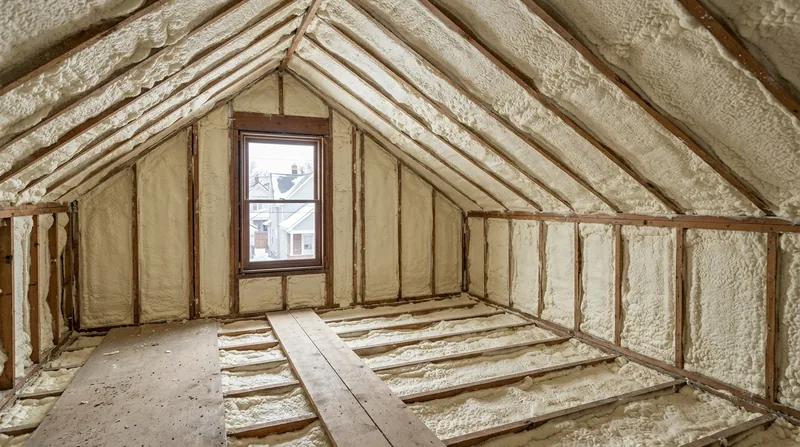




Open cell spray foam insulation in Syracuse fills the stud bays and attic rafters of the city's older frame houses, where balloon framing and decades-old fiberglass have left heat and moisture to escape into the Central New York winter. In Eastwood's two-and-a-half-story homes, Westcott's knee wall attic rooms, and the mid-century capes scattered across Liverpool and Camillus, open cell foam expands to seal every gap and cut the drafts that drive heating bills through the roof. Unlike closed cell, open cell is softer, more forgiving on older wood, and significantly cheaper per board foot, making it the practical choice for homeowners who want real air sealing without the premium price tag of denser foam. We've been installing spray foam across Onondaga County since 2012, and we know exactly where Syracuse houses leak money and how to stop it. This page walks you through how open cell works, what it costs, and how to hire the right contractor for the job.
Why Open Cell Spray Foam Matters in Syracuse's Cold Climate
Syracuse sits in IECC climate zone 5A, heating-dominated and brutally cold, with long winters and heavy lake-effect snow that piles onto roofs and creates ice dams whenever attic heat melts the bottom layer. The failure mode that dominates here is simple: warm indoor air rises all winter, pushes into uninsulated attics and walls, and deposits frost or condensation in the framing because the ceiling plane isn't sealed and the vapor retarder sits on the wrong side. Open cell spray foam fixes this by sealing the entire attic floor or the underside of the roof deck in one pass, stopping the stack effect and the moisture that comes with it.
- Fills every gap in stud bays and between rafters, stopping infiltration that fiberglass missed for decades.
- Expands to conform to irregular framing, old balloon walls, and knee wall attic rooms common in Eastwood and Tipperary Hill.
- Cures to a semi-rigid state that stays in place and does not settle like blown-in cellulose or fiberglass.
- Absorbs sound, dampening noise from attic activity and exterior weather that echoes through older frame houses.
- Costs significantly less per board foot than closed cell, making it the right choice for attic and wall cavity retrofit work across Syracuse.
In the cold, humid climate of Central New York, stopping air leakage is the single biggest driver of comfort and energy savings, and open cell spray foam does that job reliably.
Key info: Syracuse's heating season runs October through May, and the worst ice dam damage happens in January and February when lake-effect snow accumulates and warm attics melt it from below. Sealing the attic floor or roof deck with open cell foam before winter stops the heat loss that triggers dams in the first place.
For more detail on how spray foam works in attic applications, see our attic spray foam insulation page.
How We Install Open Cell Spray Foam in Syracuse Homes
The process begins with a thorough walkthrough of the space. We identify air leaks around rim joists, band joists, electrical penetrations, and any existing insulation that needs removal. We then prepare the work area, set up mechanical ventilation to control fumes during application, and confirm that the substrate is clean and dry. Open cell foam must cure in the right conditions, and we manage temperature, humidity, and air movement to ensure a proper installation that will perform for decades.
- We remove failed or contaminated insulation before we spray, leaving no compressed fiberglass or moldy cellulose under the new foam.
- We seal all air leak pathways, including rim joists, band joists, and penetrations, so the foam sits on a prepared surface.
- We spray open cell to the specified thickness and R-value in controlled passes, never overshooting or undershooting the mark.
- We maintain mechanical ventilation during cure and enforce a twenty-four to forty-eight hour re-entry window before occupants return to the space.
- We walk away from any wet, moldy, or actively leaking substrate, fixing the moisture problem first or referring it to the right trade.
The result is a sealed, insulated space with no gaps and no settling, ready to hold heat all winter and keep moisture out of the framing.
Example: A 1920s two-and-a-half-story home in Eastwood had an attic with balloon framing, no insulation in the exterior walls, and a finished knee wall bedroom that was freezing in winter. We removed the old fiberglass batts, sealed the rim joist and all exterior wall cavities with open cell foam, and insulated the attic floor to R-30. The homeowner reported a noticeably warmer second floor and a lower heating bill by December.
For details on air sealing and complementary services, visit our air sealing page.
Open Cell Spray Foam Installation Methods and Applications
| Application | Description | Best for |
|---|---|---|
| Attic Floor | Open cell sprayed across the entire attic floor to R-30 or R-38, sealing all gaps between joists and around penetrations. | Older Syracuse homes with settled fiberglass, ice dam history, and unfinished attics. |
| Sealed Roof Deck | Open cell sprayed on the underside of roof sheathing to create a sealed attic space that does not require venting. | Finished attic rooms, knee walls, and homes where attic storage or HVAC equipment will be placed. |
| Wall Cavities | Open cell injected into existing wall cavities via small holes drilled in the exterior or interior, filling the entire bay without demolition. | Balloon-framed Eastwood and Westcott homes, pre-1980 stock with uninsulated walls and no access from inside. |
| Rim and Band Joists | Open cell applied to the exposed rim joist and band board above basement or crawl space walls, sealing the thermal break. | Homes with full basements across Onondaga County, where the rim joist is the primary air leak and heat loss path. |
| Crawl Space Walls | Open cell sprayed on interior crawl space walls to seal the envelope and reduce moisture infiltration from soil. | Shallow crawl spaces under porches, additions, and mid-century ranch homes in Liverpool and Camillus. |
Each application is measured on site and specified by R-value and thickness before we spray, so you know exactly what you are getting.
Open Cell Spray Foam Insulation Cost in Syracuse: What to Expect
Open cell spray foam typically starts at $0.55 per board foot for straightforward attic and wall cavity applications. The actual cost depends on several concrete factors: the size of the space and total board footage needed, the accessibility of the work area (a finished attic room costs more to work in than an unfinished one), whether existing insulation must be removed first, and the condition of the substrate. A 1,200-square-foot attic floor insulated to R-30 with open cell typically runs between $2,500 and $4,000 installed, but that number moves based on what we find when we get there.
We always recommend getting two or three estimates from local contractors before you decide. Not all spray foam shops measure the same way, not all specify R-value and thickness in writing, and not all carry the insurance or follow the installation protocol that protects you if something goes wrong. A written estimate with board footage, R-value, and thickness specified is the baseline for any contractor worth hiring.
For a detailed breakdown of pricing across all our services, visit our pricing page. Call us at (315) 907-4259 for a free, no-obligation estimate at your address.
What to Look for When Hiring a Spray Foam Insulation Contractor Near Me in Syracuse
Spray foam is a high-skill trade, and the difference between a good installation and a bad one is invisible until the heating bill comes or the smell will not go away. When you call a contractor, ask for a written estimate that specifies R-value, thickness, and board footage, not just a price per square foot. Verify that the contractor is fully insured and ask to see the certificate of insurance. Check references from recent jobs in Syracuse, De Witt, or Liverpool, and call those homeowners to ask whether the work held up and whether the crew was professional and clean.
- Ask whether the contractor will remove old insulation before spraying, and get that in writing as part of the scope.
- Confirm that mechanical ventilation will be used during application and that a re-entry window of twenty-four to forty-eight hours will be enforced.
- Request a site visit and walkthrough so the contractor can identify all air leaks and specify the correct foam type and thickness for your space.
- Verify that the contractor knows the local building code and will work with your city's building department if a permit is required at your address.
- Ask whether the contractor will inspect the job before you pay, and whether any workmanship warranty is offered in writing.
A local contractor with a local address and local plates, who will stand behind the work and be reachable if a question comes up, is always the safer choice than an out-of-state rig-and-run crew.
Ready to get started? Contact us for a free estimate, or call (315) 907-4259 to discuss your project.
Open Cell Spray Foam Insulation in Syracuse: Pricing Guide
| Service | Price | Details |
|---|---|---|
| Open Cell Attic Floor | Starting at $0.55/board ft | Insulation to R-30 or R-38 across entire attic floor, sealed rim joists and penetrations included in scope |
| Open Cell Wall Cavity Injection | Starting at $0.55/board ft | Retrofit of exterior or interior walls without demolition, drilling and injection holes included in price |
| Sealed Roof Deck or Knee Wall | Starting at $0.60/board ft | Spray-applied to underside of roof sheathing or knee wall framing, requires ventilation control and curing time |
| Rim Joist and Band Joist Sealing | Starting at $0.55/board ft | Thermal break above basement or crawl space, typical 500 to 800 board feet per job depending on foundation perimeter |
| Insulation Removal and Replacement | On estimate | Existing fiberglass, cellulose, or failed foam must be removed first, cost depends on volume and contamination |
| Free Estimate | No charge | Site visit, written specification of board footage and R-value, response within 24 hours at (315) 907-4259 |
Indicative pricing, the exact cost depends on square footage, finish, and site access. Free personalized estimate within 24h at (315) 907-4259.


