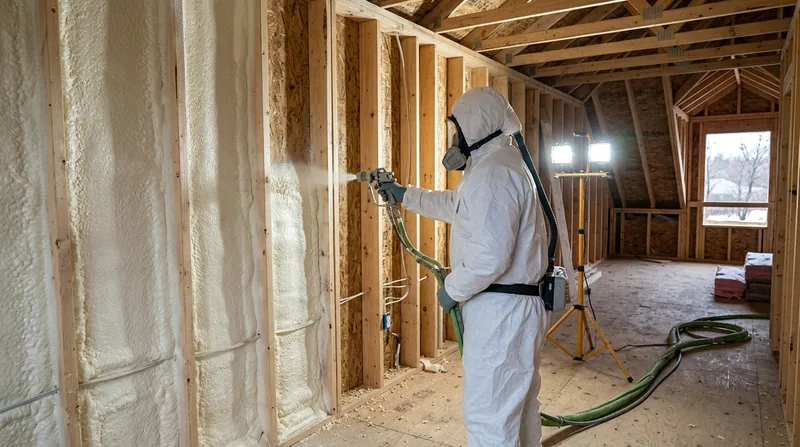




New construction and commercial buildings across Onondaga and Oneida counties face a critical decision before the drywall goes up: how to insulate walls, attics, and rim joists to meet the energy code that applies at your address. Commercial and new construction spray foam in Syracuse is not a one-size-fit-all choice. The buildings that perform best are the ones where the foam is applied while framing is still open, the substrate is clean and dry, and the installer understands the difference between a sealed roof deck and a vented attic, between closed cell and open cell, and between what the code requires and what the budget allows. We work with builders, general contractors, and property managers across Greater Syracuse to spray foam the thermal boundary before interior finishes begin, ensuring the building meets code, holds its shape, and stays dry through decades of Central New York winters.
Why Commercial and New Construction Spray Foam Matters in Syracuse
Syracuse sits in IECC climate zone 5A, a heating-dominated region where the stack effect drives warm indoor air upward all winter, pushing moisture into cold walls and attics. New construction in Clay, Cicero, and Manlius uses platform framing, but the physics are the same: if the thermal boundary is not sealed and the vapor retarder is not on the correct side of the wall, condensation forms in the cavities, frost accumulates, and the building bleeds energy for decades. The energy code in force at your address sets the minimum R-value and the air-sealing standard; the building official enforces it; and spray foam, when applied correctly, meets both in a single pass. Builders who spray foam before drywall goes up avoid callbacks, warranty disputes, and the cost of retrofit work after the building is occupied.
- Spray foam seals the thermal boundary and stops the stack effect before interior walls are framed.
- Closed cell foam at the correct thickness meets the R-value and air-sealing requirements of the current code without additional barriers.
- Open cell foam is faster and less expensive for attics and interior walls where vapor permeability is an asset.
- Rim joists, band joists, and cantilevers are sealed in one operation, eliminating the weak points where heat loss and air leakage concentrate.
- Mechanical ventilation during cure and a stated re-entry window ensure the building is safe to occupy on schedule.
The right foam choice depends on the use, the substrate, and the climate zone. We help you understand which one applies to your project.
Key info: Syracuse and surrounding towns in Onondaga County are governed by the New York State Energy Code, which is updated periodically. The code in force at your address is determined by the year of the permit application, not the year of construction completion. Your building official has the authority to interpret the code and approve or reject the insulation system you propose. We help you understand what applies at your address, but the final say belongs to the city or town where the building is located. Always verify with the local building department before starting work.
For more information on how spray foam integrates with air sealing in commercial shells, see our air sealing page.
How We Spray Foam New Construction and Commercial Buildings in Syracuse
The work begins with a walk-through of the framing before any drywall or interior finishes are installed. We identify the thermal boundary, confirm the substrate is clean and dry, and agree on the foam type, thickness, and coverage area. Spray foam is applied in controlled passes, with the ratio and drum temperature monitored to spec, and mechanical ventilation running throughout the cure period. Once the foam has set, we inspect for thickness, coverage, and any voids that need a second pass. The building is ready for drywall after the re-entry window has passed, typically twenty-four to forty-eight hours.
- We schedule the spray before drywall, HVAC rough-in, or any interior work begins.
- The substrate is inspected and cleaned of dust, debris, and standing water before foam is applied.
- Closed cell or open cell foam is sprayed at the thickness and coverage specified in the estimate and the code.
- Mechanical ventilation and temporary containment ensure safe conditions during cure and prevent off-gassing into occupied spaces.
- The installation is inspected for thickness, adhesion, and coverage before the building proceeds to the next phase.
Timing is critical in new construction. We coordinate with the general contractor and the building trades to ensure the foam is applied at the right window and does not delay other work.
Real example: A multi-unit residential building in Liverpool was framed with platform construction and an unvented attic. The energy code required R-38 in the roof deck and air sealing at all rim joists and band joists. We sprayed closed cell foam at 2.5 inches in the roof deck (R-17.5 per inch) and 1.5 inches at the rim and band joists, meeting the code and the air-sealing requirement in a single operation. The building was ready for drywall forty-eight hours after the spray, on schedule and within budget.
For details on how closed cell foam performs in sealed roof decks, visit our closed cell spray foam page.
Spray Foam Methods for Commercial and New Construction in Syracuse
| Approach | Description | Best for |
|---|---|---|
| Closed Cell Spray Foam | High-density foam at 2 to 3.5 inches per pass, R-6 to R-7 per inch, water-resistant, air-sealing barrier in one layer. | Sealed roof decks, rim and band joists, metal buildings, commercial shells where vapor control and structural support matter. |
| Open Cell Spray Foam | Lower-density foam at 3 to 5.5 inches per pass, R-3.5 to R-3.8 per inch, vapor-permeable, faster to apply. | Interior walls, attics with vented soffits, sound dampening, cost-sensitive new construction where vapor drying is available. |
| Rim and Band Joist Sealing | Closed cell foam at 1.5 to 2.5 inches applied to the rim board, band joist, and adjacent rim cavity, stopping heat loss and air infiltration. | All new construction with basements, crawl spaces, or vented rim cavities; the single largest point of heat loss in platform-frame buildings. |
| Wall Cavity Spray Foam | Open or closed cell foam sprayed into wall cavities during framing, before sheathing and weather barriers are installed. | New construction walls, additions, and commercial interiors where cavities are accessible and code requires continuous insulation or air sealing. |
Commercial and New Construction Spray Foam Cost in Syracuse: What to Expect
The cost of spray foam for new construction and commercial buildings depends on the foam type, the thickness required by the code, the square footage of the thermal boundary, and the ease of access. A free commercial estimate includes a walk-through of the framing, a review of the energy code that applies at your address, and a written proposal with the R-value, thickness, and coverage specified in board feet. The estimate is binding once you approve it; there are no surprises on the invoice. Factors that move the cost up include multiple stories, complex roof geometry, tight framing tolerances, and the need for mechanical ventilation equipment or containment during cure.
Closed cell foam costs more per board foot than open cell, but it seals the air boundary in one pass and does not require a secondary air-sealing membrane. Open cell foam is less expensive but requires careful attention to vapor management, particularly in climate zone 5A where moisture drives condensation. On a simple rectangular attic with clear access, the cost is lower; on a building with cantilevers, multiple roof planes, and interior rim joists, the cost is higher. The only way to know is to get an estimate. We provide three references and a detailed breakdown so you can compare fairly with other bidders.
For a full pricing overview and examples, visit our pricing page.
What to Look for When Hiring a Spray Foam Contractor Near Syracuse
The spray foam trade includes rig-and-run crews operating out-of-state trailers, national franchises with corporate overhead, and local independent shops. Each has a different approach to quality, accountability, and follow-up. When you are evaluating a contractor, ask for a written estimate that names the foam type, the R-value per inch, the thickness, and the total board feet. Verify that the contractor carries general liability insurance and that the policy is current. Ask for three references from commercial or new construction projects completed in the past two years, and call them. Confirm that the contractor understands the energy code that applies at your address and can explain why they chose the foam type and thickness they specified. If the estimate is missing R-values and thickness, or if the price is far below market with no inspection, walk away.
New York law does not require spray foam installers to hold a state license or registration, but local building departments may require a contractor registration or a master plumber license if you are working in a municipality with its own contractor board. Always verify with the building official at your address before hiring. The contractor should be willing to coordinate with the building official and provide inspection documentation after the foam has cured. If the contractor promises immediate re-entry or guarantees there will be no odor, be skeptical: correct installation requires mechanical ventilation during cure and a stated re-entry window of twenty-four to forty-eight hours.
Ready to get started? Contact us for a free commercial estimate. We are fully insured and have been serving Greater Syracuse since 2012.
Commercial & New Construction Spray Foam in Syracuse: Pricing Guide
| Service | Price | Details |
|---|---|---|
| Free commercial estimate | Free | Walk-through of framing, code review, written proposal with R-value, thickness, and board feet |
| Closed cell spray foam | Starting at $1.50 per board foot | High-density, air-sealing barrier, sealed roof decks and rim joists, 2 to 3.5 inches per pass |
| Open cell spray foam | Starting at $0.85 per board foot | Lower-density, vapor-permeable, interior walls and attics, 3 to 5.5 inches per pass, faster application |
| Travel and coordination | Included | No separate charge for travel within Syracuse and surrounding towns; coordination with general contractor included |
| Complex or multi-building projects | On estimate | Requires site visit to assess access, substrate condition, mechanical ventilation needs, and cure containment |
| Response time | Within 24 hours | Call (315) 907-4259 or submit the form on our contact page; estimate is no-obligation |
Indicative pricing, the exact cost depends on square footage, finish, and site access. Free personalized estimate within 24h at (315) 907-4259.


