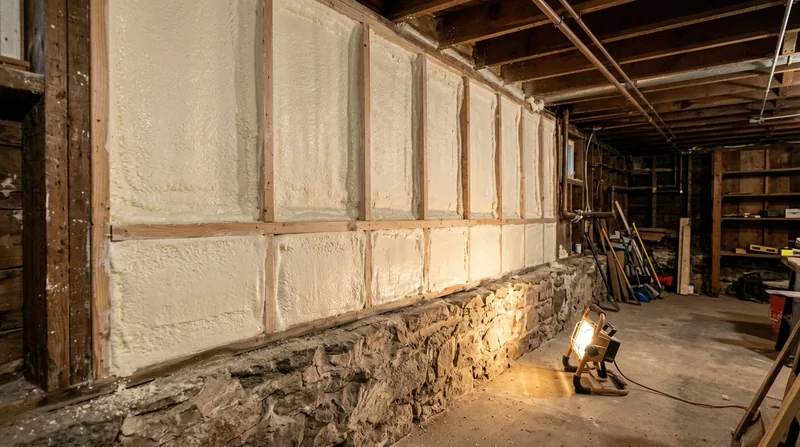




Closed cell spray foam insulation in Syracuse stops heat loss and air infiltration where other insulation fails. Syracuse winters are long and brutal, with heating-dominated demand that drives energy costs higher every year. Homes across Onondaga County, from the balloon-frame houses in Eastwood and Tipperary Hill to the mid-century capes in Liverpool and Camillus, bleed warm air through rim joists, basement walls, and uninsulated cavities that fiberglass and blown-in insulation cannot seal. Closed cell foam creates a true air barrier with an R-value of 6 to 7 per inch, stopping both heat loss and moisture infiltration before they start. This matters in a climate where stack effect pushes warm, humid indoor air upward all winter, settling as frost and condensation in cold attics and walls unless the ceiling plane and rim are sealed tight. We install closed cell spray foam in attics, basement walls, rim joists, crawl spaces, and retrofit cavities across Greater Syracuse, helping homeowners cut heating costs and prevent the moisture damage that plagues older and mid-century stock.
Why Closed Cell Spray Foam Matters in Syracuse's Cold, Humid Climate
Syracuse sits in IECC climate zone 5A, where winters are long, heating demand is constant, and moisture control is as important as R-value. The stack effect is relentless: warm indoor air rises all winter and pushes into the attic and walls, where it meets cold exterior surfaces and condenses into frost, water, or ice. Fiberglass and cellulose cannot stop this airflow, and neither can they create a vapor barrier that keeps moisture on the warm side of the wall. Closed cell foam does both. It seals every gap, crack, and cavity with a continuous air barrier, and its closed-cell structure resists moisture infiltration from outside while its density (1.5 to 2 pounds per cubic foot) allows vapor to move safely inward and then outward with seasonal changes. For rim joists on basements across Onondaga County, for balloon-frame cavities in early-1900s stock, and for basement walls that leak cold and dampness, closed cell is the only insulation that truly works.
- Closed cell foam creates a continuous air barrier that stops infiltration and exfiltration in a single pass.
- It achieves R-6 to R-7 per inch, so a 2-inch layer in a rim joist meets or exceeds code R-value requirements in zone 5A.
- The foam's closed-cell structure resists moisture and prevents condensation in cold attics and basement walls where humidity and cold collide all winter.
- It bonds directly to wood, concrete, and metal, filling voids that fiberglass and blown-in insulation leave open.
- Once cured, closed cell foam is rigid and provides structural bracing to rim joists and basement walls, improving racking resistance.
In Syracuse, closed cell spray foam stops the heat loss and moisture problems that fiberglass alone cannot address.
Key info: Homes in Liverpool, Camillus, and De Witt with open rim joists and stone or block foundations lose enormous amounts of heat and draw in cold, humid air all winter. Closed cell foam seals both the rim and the rim band, stopping infiltration and condensation in one step. A typical rim joist retrofit is 2 to 3 inches thick and takes one day to cure.
For more information on how air sealing and insulation work together, visit our air sealing service page.
How We Install Closed Cell Spray Foam Insulation in Syracuse Homes
Closed cell spray foam installation is a controlled, multi-step process that depends on correct equipment, ratio, temperature, and ventilation. We arrive with a spray rig, mix the closed cell formula at the proper ratio and drum temperature, and apply it in thin passes (typically 0.5 to 1 inch per pass) to ensure full rise, proper density, and complete cure. The substrate must be clean, dry, and free of moisture. If we find water, ice, condensation, or active leaks, we walk away and help the homeowner fix the moisture first. Mechanical ventilation runs during application and for 24 to 48 hours after, depending on temperature and humidity. Once cured, closed cell foam hardens into a rigid, structural material that bonds permanently to wood, concrete, and steel.
- We visit the job, measure the area to be foamed, and check the substrate for moisture, contamination, or damage.
- We establish mechanical ventilation (fans, open doors or windows) to move fumes out of the home during application and cure.
- We apply closed cell foam in thin, controlled passes, allowing each pass to rise and cure before the next layer goes down.
- We verify thickness and density during the job, documenting the R-value and board-foot total on your estimate and final invoice.
- We post a re-entry notice on the home stating the 24 to 48 hour cure window, after which the space is safe to occupy.
- We remove all equipment, tape, and debris, leaving the foam ready for drywall, vapor barrier, or other finishing work.
This approach ensures that every job meets code R-value, cures properly, and poses no risk to occupants or workers.
Example: A 1,200-square-foot attic in North Syracuse with flattened fiberglass and no air sealing typically takes 4 to 6 hours to spray 2 inches of closed cell foam (2,400 board feet). The homeowner stays out for 24 to 48 hours. Once cured, the attic is sealed, insulated to R-12 to R-14, and ready for drywall or storage.
For attic-specific guidance, see our attic spray foam insulation service page.
Closed Cell Spray Foam Methods and Applications
| Application | Closed Cell Approach | Why It Works in Syracuse |
|---|---|---|
| Rim and Band Joists | 2 to 3 inches sprayed directly onto rim, band, and rim band, filling all voids and cavities. | Stops cold air infiltration and condensation on stone, block, or poured foundations; creates an unbroken seal against basement dampness and heating loss. |
| Basement Walls | 1.5 to 2 inches sprayed directly onto foundation walls, above the rim and below grade. | Provides R-9 to R-14, stops moisture infiltration from outside, and prevents condensation on cold concrete in winter. |
| Balloon-Frame Cavities | 2 to 4 inches injected into wall cavities from inside or outside, filling voids that fiberglass cannot reach. | Seals the continuous cavities in early-1900s homes in Eastwood, Tipperary Hill, and Strathmore; stops air leakage and heat loss in uninsulated walls. |
| Attic Sealed Decks | 2 to 4 inches sprayed on the underside of roof sheathing, creating a conditioned attic with no ventilation. | Stops ice dams caused by heat loss from the attic melting snow from below; eliminates frost and condensation in finished attic rooms and knee walls. |
| Crawl Spaces | 2 to 3 inches sprayed on rim, band, and perimeter walls above the crawl space floor. | Seals the crawl space boundary, stops cold air infiltration into floors above, and prevents moisture from rising into the home. |
Closed cell foam is the best choice for moisture-prone and cold-sensitive areas where air sealing and high R-value are both required.
Closed Cell Spray Foam Insulation Cost in Syracuse: What to Expect
Closed cell spray foam typically starts at $1.20 per board foot for straightforward jobs like rim joists, basement walls, and attic rim sealing. A typical rim joist retrofit on a 1,500-square-foot home (50 to 80 linear feet of rim) runs 150 to 240 board feet and costs between $180 and $290 before tax. An attic sealed deck on the same home, if it is 1,200 square feet and gets 2 inches of closed cell foam, is 2,400 board feet and costs $2,880 to $3,600 before tax. These figures assume clean, dry, accessible surfaces and no substrate prep or removal. Prices move up if the substrate is wet or contaminated, if access is difficult, if existing insulation must be removed first, or if the job is complex or requires special equipment.
We provide written estimates with R-value and thickness specifications, so you know exactly what you are paying for and why. Two or three estimates from local contractors are always smart. Be wary of quotes with no R-value listed, no thickness, no ventilation plan, immediate re-entry promised, or prices far below market. Those are the markers of corners cut during installation, and they cost you later in poor performance, odor, and warranty disputes.
For a detailed pricing breakdown and examples of typical jobs, visit our full pricing page.
Cost factors: Substrate condition (clean and dry versus wet or contaminated), access (basement versus attic versus crawl space), thickness (2 inches versus 4 inches), board-foot volume, and whether removal of old insulation is needed all affect the final price. A free estimate by phone or on-site gives you the exact number for your home.
Closed Cell Spray Foam Insulation Near Me: What to Look for When Hiring a Contractor in Syracuse
Hiring the right spray foam contractor is critical. The work is technical, the product is regulated, and poor installation leaves you with odor, performance failures, and warranty disputes that are hard and expensive to fix. When you are looking for a closed cell spray foam contractor near Syracuse, ask the right questions and verify the answers. A good contractor will give you an estimate in writing, with R-value and thickness clearly stated. They will explain their ventilation plan and re-entry window. They will carry full insurance and be able to provide a certificate of insurance on request. They will tell you what permits apply at your address and help you navigate them, but they will not promise to pull all permits themselves, because permitting rules vary from city to city across Greater Syracuse and Onondaga County, and there is no reciprocity between towns.
- Ask for an estimate in writing that includes R-value per inch, total thickness, board-foot volume, and price per board foot.
- Verify that the contractor carries full insurance and ask for a certificate naming you as additional insured for the duration of the job.
- Ask how many jobs the contractor has done and request references from homeowners in Syracuse, Liverpool, or Camillus whose work you can verify.
- Understand what permits are required at your address by calling your local building department, and ask the contractor how they will help you comply.
- If you live in an HOA community or a historic district, check your architectural rules before you book; exterior work and some interior retrofits may require approval.
- Never accept a price far below market, immediate re-entry promises, or an estimate with no R-value or thickness listed; these are red flags for poor installation.
A local contractor with a local address, local insurance, and a track record in Syracuse is your best protection against the rig-and-run crews and out-of-state franchises that cut corners and vanish when problems arise.
Ready to get started? Contact us for a free, no-obligation estimate. Call (315) 907-4259 or fill out our online form, and we will respond within 24 hours with a time to visit your home or building.
Closed Cell Spray Foam Insulation in Syracuse: Pricing Guide
| Service | Price | Details |
|---|---|---|
| Rim and Band Joist Sealing | Starting at $1.20/board ft | Typical rim retrofit is 150 to 300 board feet; cost depends on rim length, rim condition, and access to basement or crawl space. |
| Basement Wall Insulation | Starting at $1.20/board ft | 2-inch closed cell on basement walls runs 200 to 500 board feet depending on wall height and total square footage of walls to be foamed. |
| Attic or Sealed Roof Deck | Starting at $1.20/board ft | 1,500 to 3,000 board feet typical for a full attic; cost scales with square footage and thickness needed to meet code R-value in zone 5A. |
| Balloon-Frame or Cavity Retrofit | Starting at $1.20/board ft | Pre-1980 wall cavities require injection or removal-and-spray; board-foot volume depends on cavity size and wall length to be filled. |
| Substrate Prep or Insulation Removal | On estimate | If existing insulation must be removed, substrate must be cleaned and dried, or moisture issues must be addressed first, pricing is quoted on-site. |
| Free Estimate | No charge | Response within 24 hours at (315) 907-4259; includes on-site measurement, R-value and thickness recommendations, and written quote. |
Indicative pricing, the exact cost depends on square footage, finish, and site access. Free personalized estimate within 24h at (315) 907-4259.


