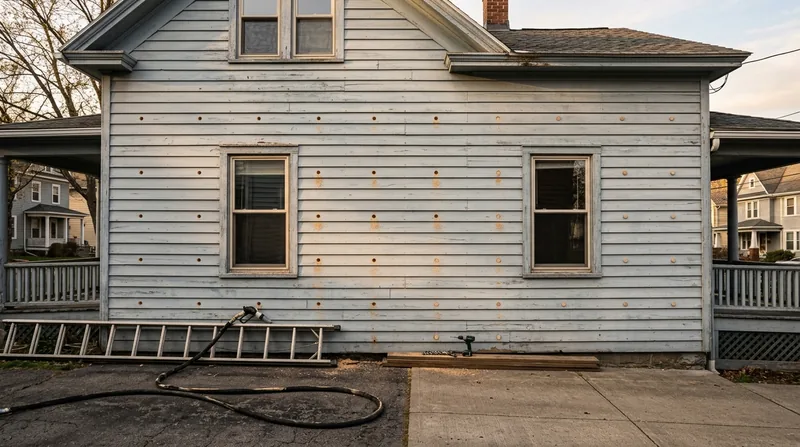




Wall & Injection Foam Insulation in Syracuse addresses one of the oldest and most persistent energy losses in Central New York: uninsulated wall cavities in balloon-frame homes built before 1950. Eastwood, Strathmore, Tipperary Hill and other Syracuse neighborhoods contain thousands of two-and-a-half-story frame houses with hollow walls that have bled heat into the winter sky for a century. Injection foam reaches into those cavities without tearing plaster or drywall, sealing air leaks and adding R-value where conventional retrofit would mean gutting the interior. In zone 5A climate like Syracuse, where heating dominates and winter stack effect pushes warm indoor air upward into cold walls, this method stops the loss at the source. We drill small holes in the exterior or interior, inject closed-cell or open-cell foam into the cavity, and seal the holes. The result is a finished wall that holds heat instead of leaking it.
Why Wall & Injection Foam Insulation Matters in Syracuse's Older Homes
Syracuse's residential core was built when insulation was either absent or minimal. A 1920s balloon-frame house in Eastwood has exterior walls that are essentially hollow channels from basement to roof, with no thermal break and no air barrier. Winter air infiltration through gaps around electrical outlets, window frames and rim joists combines with conduction loss through bare studs and sheathing. The heating bill climbs. Interior comfort falls. Moisture migrates into the wall cavity as warm interior air meets cold sheathing, condensing in winter and creating conditions for decay or mold if the wall cannot dry. Injection foam stops this cycle by filling the cavity completely and creating a continuous vapor retarder on the warm side of the assembly.
- Fills hollow wall cavities in balloon-frame and platform-frame homes without demolition or interior disruption.
- Seals air leaks at the cavity perimeter and around embedded utilities and fasteners.
- Adds R-value ranging from R-3.6 per inch (open cell) to R-6.5 per inch (closed cell) depending on foam type and cavity depth.
- Creates a continuous vapor retarder that prevents moisture migration into the wall assembly during the heating season.
- Works on exterior or interior access points, and drilling can be hidden behind trim, siding or interior finishes.
Homeowners across Syracuse, Liverpool, Camillus and DeWitt report noticeably warmer interior walls and lower draft sensation after injection foam, especially in rooms above basements or on the north and west exposures where winter wind load is highest.
Key info: Many Syracuse homes built before 1980 have no insulation in exterior walls. A typical two-story house with 2,000 square feet of wall area can lose 20 to 30 percent of its heating energy through uninsulated walls. Injection foam retrofit can recover much of that loss without opening the walls.
For more on how we approach air sealing around injection foam work, see our air sealing service page. If your home also needs attic insulation or rim joist sealing, we handle both as part of the same energy envelope strategy.
How We Inject Foam Into Syracuse Walls: Our Process
Injection foam retrofit starts with a site visit to assess the wall cavity depth, identify utilities and structural elements, and determine whether the wall is suitable for injection. Not all walls are candidates: walls with existing insulation, severe moisture, or structural damage need evaluation first. We then plan access points, typically on the exterior between studs or on the interior if exterior work is not feasible. Drilling is precise and holes are sealed immediately after injection. The process is fast and creates minimal mess compared to opening walls or removing plaster.
- Walk the exterior and interior, photograph the wall assembly, and confirm cavity depth and condition with a moisture meter and visual inspection.
- Mark drilling points on a grid, typically 16 inches apart vertically, and confirm no utilities (electrical, plumbing, gas) are in the path.
- Drill a 1-inch hole through the rim or sheathing, insert the injection wand, and dispense foam at a controlled rate to fill the cavity without overpressure.
- Monitor cavity pressure and fill height to avoid foam overflow and ensure complete fill from sill to top plate.
- Seal all holes with expanding foam backer rod and finish with caulk or patching compound matched to the substrate.
- Allow cure time (typically 24 to 48 hours for closed cell, longer for open cell) before painting, siding or trim work.
A typical wall section on a Strathmore or Eastwood home takes 4 to 8 hours depending on cavity size, access, and whether work is done from outside or inside. We schedule the job to avoid occupant disruption and plan drilling access before arrival.
Example: A 1,200 sq ft exterior wall on a Liverpool cape with 3.5-inch cavities and no existing insulation took 6 hours to inject with closed-cell foam, yielding approximately R-23 in the cavity. Drilling was done from the exterior, and holes were sealed with foam backer and exterior caulk. Interior plaster remained untouched. Winter heating bills dropped noticeably in the following season.
For walls where injection is not suitable, we offer insulation removal and replacement services to strip failed or contaminated insulation and start fresh with spray foam.
Injection Foam Methods: Closed Cell vs. Open Cell for Syracuse Walls
| Foam Type | R-Value per Inch | Best for | Considerations |
|---|---|---|---|
| Closed-Cell Spray Foam | R-6.0 to R-6.5 | Walls in zone 5A where vapor control and maximum R-value are priorities; exterior walls in Syracuse exposed to winter wind load. | Higher cost, denser, acts as vapor retarder, requires proper thickness to avoid condensation issues on the interior face. |
| Open-Cell Spray Foam | R-3.5 to R-3.8 | Interior walls, partition walls, or cavities where cost is a constraint and the wall has a separate vapor retarder on the interior. | Lower cost, lighter, more permeable, requires interior vapor barrier (paint, drywall) to manage moisture in heating-dominated climate. |
| Closed-Cell Injection (Partial Fill) | R-6.0 to R-6.5 | Retrofit of existing cavities where full demolition is unacceptable; balloon-frame homes in Eastwood, Strathmore, Tipperary Hill. | Injected at controlled density, fills cavities without overpressure, cures in 24 to 48 hours, minimal downtime. |
| Open-Cell Injection | R-3.5 to R-3.8 | Interior walls where cost is primary driver and exterior vapor control is not critical; sound dampening applications. | Lighter density, expands more, requires longer cure time, permeable to moisture, needs interior vapor barrier in cold climates. |
For Syracuse's climate and building stock, closed-cell injection foam is the standard choice on exterior walls because it provides vapor control and high R-value in tight cavities. Open cell is appropriate for interior partition walls or where cost is the deciding factor and a paint or drywall vapor barrier already exists on the warm side.
Wall & Injection Foam Insulation Cost in Syracuse: What to Expect
Injection foam pricing in Syracuse typically starts at $2 to $4 per square foot of wall area, depending on cavity depth, foam type, access difficulty, and whether drilling is done from the exterior or interior. A standard 3.5-inch exterior wall cavity filled with closed-cell foam costs more per square foot than a shallow interior partition filled with open cell. Labor is the dominant cost driver: drilling, injecting, sealing and curing all require time on site and careful technique to avoid overflow, under-fill or damage to existing finishes.
Key factors that affect your final cost include cavity depth (deeper cavities require more material and more careful injection technique), foam type (closed cell is higher cost than open cell), access (exterior drilling on a two-story home requires scaffolding or lift access, raising labor cost), and the presence of existing insulation or utilities that complicate the job. A single-story ranch in DeWitt with straightforward exterior access and no obstructions will cost less than a two-and-a-half-story balloon-frame home in Eastwood with multiple utilities and interior access only.
We recommend getting 2 to 3 estimates from local contractors before deciding. A written estimate should specify the foam type (closed cell or open cell), the planned cavity depth and fill height, the R-value you will receive, the total square footage of wall area, and the breakdown of material and labor. Be wary of estimates with no R-value specification, no thickness detail, or a price far below the market rate, as these often signal rushed work, under-fill, or inadequate insurance.
For a full breakdown of pricing and to discuss your specific wall area and cavity conditions, visit our pricing page or call us at (315) 907-4259 for a free estimate. We also help homeowners understand whether their wall is a candidate for injection or whether removal and replacement with spray foam is the better path.
Wall & Injection Foam Insulation Near Me: What Syracuse Homeowners Should Know When Hiring
Choosing the right contractor for injection foam retrofit is as important as choosing the foam type itself. A poor installation, characterized by under-fill, overflow, inadequate sealing of access holes, or immediate re-entry before cure, can leave you with drafts, odor, or failed insulation within months. The best way to protect yourself is to verify a contractor's track record, confirm insurance coverage, get multiple estimates with written specifications, and ask for references from recent jobs in your neighborhood.
Start by confirming that any contractor you interview carries full insurance coverage and can provide a certificate of insurance on request. Ask whether they pull permits for your city (permitting rules vary across Syracuse, DeWitt, Liverpool and surrounding municipalities, and some cities require permits for interior wall work). Request a written estimate that includes the foam type, cavity depth, R-value, square footage, and a timeline for cure. Check references from homeowners in Syracuse or nearby areas, and ask those references about the contractor's communication during and after the job, their handling of the re-entry window (the time before the foam is fully cured and the space can be occupied), and whether any odor or off-gassing issues occurred.
- Confirm full insurance coverage and ask to see the certificate before work begins.
- Get a written estimate with foam type, R-value, cavity depth, square footage and labor timeline clearly stated.
- Ask about permitting and whether the contractor will help you navigate what your city requires.
- Request at least two references from recent wall injection jobs in Syracuse or the immediate area.
- Clarify the re-entry window (typically 24 to 48 hours for closed cell) and any ventilation or occupancy restrictions during cure.
- Verify that access holes will be sealed with foam backer rod and caulk or patching compound, not left open or partially filled.
Avoid contractors who promise immediate re-entry, offer prices far below market, cannot describe the foam type or R-value, or decline to provide references. These are markers of rushed work and poor quality control. The local independent contractor with a local address and a reputation in Syracuse neighborhoods is typically a safer choice than a national franchise or an out-of-state crew that moves from job to job without accountability.
Ready to move forward? Contact us for a free estimate and we will walk you through the process, answer your questions about permits and re-entry, and provide references from recent jobs in your area. You can also reach us at (315) 907-4259.
Wall & Injection Foam Insulation in Syracuse: Pricing Guide
| Service | Price | Details |
|---|---|---|
| Injection Foam (Closed-Cell, 3.5 to 5.5 inch cavity) | Starting at $3/sq ft | Typical exterior wall retrofit in Syracuse balloon-frame homes; includes drilling, injection, and access hole sealing with foam and caulk |
| Injection Foam (Open-Cell, interior partition walls) | Starting at $2/sq ft | Lower cost option for interior walls where vapor control is not critical; same labor process as closed cell but less material cost |
| Complex wall retrofit (multiple utilities, difficult access, two-story) | On estimate | Exterior drilling on two-story homes, walls with embedded plumbing or electrical, or interior access only require site assessment to price accurately |
| Removal and replacement of failed insulation before injection | Starting at $1.50/sq ft | Includes removal of existing insulation, cleanup, and surface preparation before new foam injection; quoted separately from foam cost |
| Travel and site visit | Included | No mileage fee or travel charge for Syracuse and surrounding service areas; free estimate within 24 hours of your call |
| Free Written Estimate | No charge | Includes R-value and thickness specifications, square footage calculation, and detailed breakdown of material and labor costs |
Indicative pricing, the exact cost depends on square footage, finish, and site access. Free personalized estimate within 24h at (315) 907-4259.


