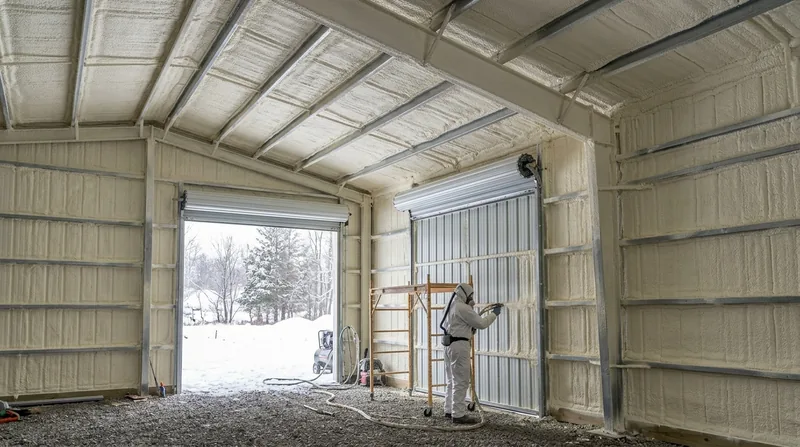




Metal building and barndominium spray foam insulation in Syracuse solves a problem that metal structures face all winter long: condensation. When warm air inside meets the cold steel panels and purlins of an uninsulated metal building, moisture condenses on the interior surfaces, dripping onto equipment, stored goods, and finished spaces below. Across Oneida and Oswego counties, closed cell spray foam stops that drip by adhering directly to the steel, creating an air and vapor barrier that keeps warm air from reaching the cold metal skin. Syracuse sits in IECC climate zone 5A with long, brutal winters and heavy lake-effect snow that amplifies the temperature swing between inside and outside. Metal barndominiums, agricultural storage buildings, and commercial shells in Liverpool, Camillus, Auburn, and surrounding areas are built for function, not thermal control, and they leak money and moisture until the envelope is sealed. We spray closed cell foam directly onto the underside of metal panels and purlins, stopping condensation at its source and creating a finished, insulated interior that holds heat and stays dry.
Why Metal Building Insulation Matters in Central New York
Metal buildings and barndominiums dominate the industrial and agricultural landscape of Oneida, Oswego, Madison, and Cayuga counties. Unlike stick-frame houses with attics and crawl spaces, metal structures have no thermal mass and no air gaps to insulate. The steel shell is the building envelope, and in Syracuse's climate, that means condensation forms every winter. The temperature differential between a heated interior and the outdoor air can exceed 60 degrees on the coldest days, and that gradient pulls moisture into the metal panels. Without insulation and air sealing, the interior becomes wet, equipment rusts, and the cost of heating climbs because warm air escapes through every seam and rivet.
- Closed cell spray foam adheres to steel and creates a seamless thermal and moisture barrier that fiberglass batts and blown-in insulation cannot match.
- The foam cures and hardens into a rigid layer that supports itself and does not sag, settle, or compress over decades like traditional insulation.
- Metal buildings in Syracuse and surrounding areas benefit from the R-value stability of closed cell foam, which does not degrade in the presence of moisture or temperature cycling.
- Air sealing at the same time the foam is sprayed eliminates the stack effect that draws humid interior air into wall cavities and attic spaces.
- Condensation control on metal buildings is not optional in zone 5A; it is the difference between a usable interior and a rusted shell.
Stopping condensation before it starts is the most cost-effective maintenance decision a metal building owner can make.
Key info: A metal barn in Liverpool or a barndominium shell in Auburn that heats to 65 degrees indoors while outdoor temperatures drop to 10 degrees will sweat condensation on every uninsulated surface. Closed cell foam sprayed to a thickness of 2 to 3 inches stops that drip and keeps the interior dry year-round. For regulatory guidance on metal building insulation and ventilation requirements in your jurisdiction, contact your local building department or review the energy code in force at your address.
How We Spray Metal Building and Barndominium Insulation in Syracuse
Spray foam insulation on a metal building is a controlled, multi-step process that begins with a site inspection and ends with a finished, sealed thermal envelope. We assess the building's current condition, identify all air leaks and thermal weak points, and determine the foam thickness and application method that will meet your heating and moisture control goals. The foam is applied in thin passes, building up the specified R-value layer by layer, with mechanical ventilation running throughout the cure period to manage fumes. We do not rush the job, and we do not promise immediate re-entry; the honest timeline is 24 to 48 hours before the space is safe to occupy without respiratory protection.
- We inspect the interior and exterior of the metal building, checking for existing insulation, air leaks, moisture damage, and structural condition of the panels and framing.
- We discuss R-value requirements, foam type (closed cell versus open cell), and the specific areas to be sprayed, then provide a written estimate with thickness and R-value specifications.
- We prepare the space by protecting equipment, stored materials, and openings, and we stage mechanical ventilation equipment to run during and after the spray application.
- We apply closed cell spray foam in thin passes, monitoring drum temperature, ratio, and application technique to ensure consistent density and adhesion to the steel.
- We verify thickness and coverage with probes and visual inspection, then establish a re-entry window and provide written guidance on ventilation and occupancy timing.
- We clean up all equipment and debris, and we remain available for follow-up questions during the cure period.
The entire process is documented with photographs and a final report that includes the foam type, thickness, R-value achieved, and the date of application.
Example: A metal agricultural building in North Syracuse used for equipment storage and occasional indoor work was losing heat and accumulating condensation on the roof purlins every winter. We sprayed 2.5 inches of closed cell foam directly to the underside of the metal roof and walls, achieving an R-value of approximately 15 to 17 per inch. The interior temperature stabilized, condensation stopped, and the building became usable for year-round storage without rust or moisture damage. The foam also provided sound dampening, reducing the noise of wind and rain on the metal roof.
Metal Building Insulation Methods and Approaches
Closed cell and open cell spray foams have different properties and different roles in metal building insulation. Closed cell foam is denser, more rigid, and provides superior vapor resistance, making it the standard choice for metal structures where condensation control is the primary goal. Open cell foam is lighter, softer, and more sound-absorbent, but it does not provide the same moisture barrier and is less common in metal building applications. The choice depends on your budget, the building's use, and whether vapor control or sound dampening is the priority.
| Approach | Description | Best for |
|---|---|---|
| Closed Cell Spray Foam | High-density foam sprayed to 2 to 4 inches, providing R-value of 6 to 7 per inch and a vapor retarder in one application. Adheres firmly to steel and hardens into a rigid, structural layer. | Metal buildings and barndominiums where condensation control and energy efficiency are equally important. Agricultural storage, equipment shelters, and heated metal structures in zone 5A. |
| Open Cell Spray Foam | Lower-density foam sprayed to 4 to 8 inches, providing R-value of 3.5 to 4 per inch. Softer, more compressible, and offers excellent sound dampening. Requires a separate vapor retarder on the interior. | Metal buildings used as shops, workshops, or barndominiums where sound control and lower upfront cost are priorities, and where interior drywall or sheathing will provide the vapor barrier. |
| Combination: Closed Cell Plus Interior Finish | Spray 1.5 to 2 inches of closed cell foam for condensation control and air sealing, then add drywall, trim, and mechanical systems to create finished living or work space. | Barndominiums and metal buildings being converted to residential or office use. Provides both thermal performance and a finished interior surface in one logical sequence. |
| Retrofit of Existing Insulation | Spray foam applied over the top of existing fiberglass, blown-in, or batts to seal air gaps and add R-value without full removal. Requires inspection to confirm the substrate is sound and dry. | Metal buildings with old or compressed insulation that still has structural integrity. Reduces labor and cost compared to complete removal and replacement. |
Metal Building and Barndominium Spray Foam Cost in Syracuse: What to Expect
The cost of spray foam insulation on a metal building depends on the building's size, the foam type and thickness you choose, access to the application surface, and the complexity of the structural layout. Closed cell foam costs more per board foot than open cell, but it delivers higher R-value per inch and superior condensation control, making it the standard for metal structures in Syracuse's climate. A straightforward metal barn or agricultural building with a simple roof and wall geometry will cost less per square foot than a barndominium with complex interior framing, mechanical systems, and finished spaces. We provide written estimates that specify the foam type, thickness in inches, R-value target, total board feet, and the price range for your specific building.
Starting at $1.75 per square foot for closed cell foam applied to a metal roof or wall, the actual cost typically ranges from $1.75 to $3.50 per square foot depending on building size, access, and the thickness required to meet your R-value goals. Larger buildings with simple geometry and good access cost less per square foot than smaller, complex structures. A 2,400-square-foot metal barn roof sprayed to 2.5 inches of closed cell foam might cost $4,200 to $8,400, while a 1,200-square-foot barndominium interior with walls and ceiling might cost $2,100 to $4,200. Travel and setup are included in our pricing for jobs in Syracuse and surrounding areas. We recommend getting 2 to 3 estimates from local contractors so you can compare specifications, not just price; an estimate without R-value, thickness, and board-foot calculations is not a real bid.
For a detailed pricing overview and examples of typical jobs in your area, visit our full pricing page. To schedule a free, no-obligation estimate, call us at (315) 907-4259 or visit our contact page.
What to Look for When Hiring a Spray Foam Contractor Near Me in Syracuse
Choosing the right spray foam contractor for your metal building is critical because poor installation can leave you with condensation, off-gassing, and wasted money. The spray foam trade attracts both experienced local shops and traveling crews that spray a job in an afternoon and are unreachable when problems emerge. A good contractor is fully insured, provides written estimates with R-value and thickness specifications, uses mechanical ventilation during the cure period, and stands behind the work with a clear warranty and contact information. Ask for references from local jobs, verify that the contractor understands the building code requirements for thermal barriers and ignition barriers in your city, and confirm that they will inspect the substrate before spraying to ensure it is dry and sound.
- Confirm that the contractor is fully insured and can provide a certificate of insurance naming your building as an additional insured during the work.
- Request a written estimate that specifies the foam type, thickness in inches, R-value per inch, total board feet, and the price, not just a per-square-foot guess.
- Ask how the contractor manages fumes and moisture during the cure period, and what re-entry window they recommend before the space is occupied or ventilated normally.
- Verify that the contractor understands the permitting and building code requirements for your city and county, and will help you navigate what applies at your address.
- Check references from at least two local metal building or barndominium projects completed in the past two years, and ask about condensation control and durability.
- Confirm that the contractor will inspect the roof, walls, and framing before the spray date to identify any moisture, damage, or air leaks that must be addressed first.
A contractor who walks away from a wet or contaminated substrate is a sign of integrity, not a limitation; fixing the moisture first is the only way to ensure the foam bonds correctly and the building stays dry.
For more information on our process and to get started with a free estimate, contact us at (315) 907-4259. We serve metal building and barndominium owners across Syracuse, De Witt, Solvay, Liverpool, Auburn, Oswego, and surrounding areas in Onondaga, Oneida, Oswego, Madison, Cayuga, and Tompkins counties. We also offer closed cell spray foam insulation and air sealing services for attics, crawl spaces, and other applications.
Metal Building & Barndominium Spray Foam in Syracuse: Pricing Guide
| Service | Price | Details |
|---|---|---|
| Closed Cell Spray Foam, Metal Roof or Wall | Starting at $1.75/sq ft | Two to three inches applied to metal panels and purlins, R-value 15 to 21, includes air sealing and condensation control |
| Closed Cell Spray Foam, Complex Interior or Barndominium | Starting at $2.25/sq ft | Three to four inches on walls, ceiling, and structural elements where foam must work around mechanical systems and finished spaces |
| Open Cell Spray Foam, Metal Building | Starting at $1.25/sq ft | Four to six inches for sound dampening and thermal value, requires separate vapor barrier on interior, best for unheated or partially heated structures |
| Retrofit or Top-Up of Existing Insulation | Starting at $1.50/sq ft | Spray foam applied over existing fiberglass or blown-in insulation to seal air gaps and add R-value without full removal and disposal |
| Travel and Setup | Included | No separate mileage or mobilization fee for jobs in Syracuse, De Witt, Liverpool, Auburn, Oswego, and surrounding Onondaga County areas |
| Free Written Estimate | No cost, no obligation | Includes site inspection, R-value and thickness specifications, board-foot calculation, and price range, response within 24 hours at (315) 907-4259 |
Indicative pricing, the exact cost depends on square footage, finish, and site access. Free personalized estimate within 24h at (315) 907-4259.


