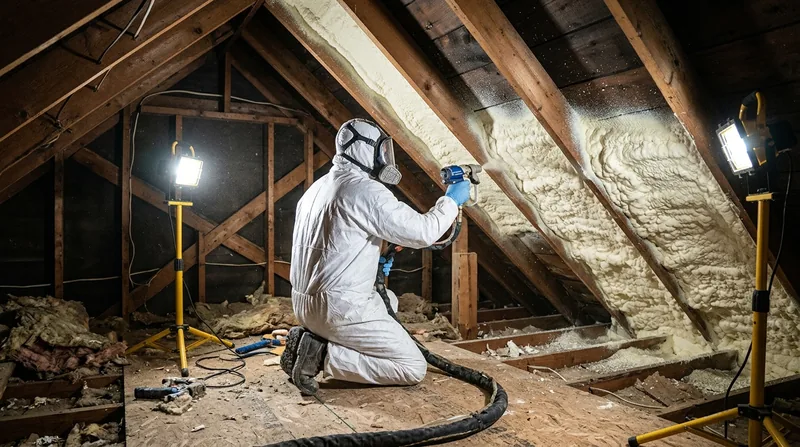




Syracuse's heating bill is the real story. Winter after winter, warm air rises through uninsulated attics and drafty rim joists in Eastwood, Westcott, and Strathmore, melting snow from below and triggering ice dams that tear gutters and rot fascia. Decades-old fiberglass insulation flattens, settles, and stops working. Balloon-frame walls in early-1900s homes carry zero insulation in the cavities themselves. Mid-century capes and ranches across Liverpool, Camillus, and DeWitt sit on rim joists that pour heat straight into the basement. Insulation replacement and re-insulation in Syracuse means tearing out failed batts and blown-in material, sealing the air leaks that let your money escape, and installing spray foam or fresh blown-in insulation sized for a heating-dominated climate. We remove the old, close the bypasses, and put back the right system for Central New York. Call us at (315) 907-4259 for a free written estimate with R-value and thickness specs, or visit our homepage to learn how we work.
Why Insulation Replacement & Re-Insulation Matters in Syracuse's Cold Climate
In IECC climate zone 5A, heating costs dominate the energy bill. Old fiberglass insulation compacts and loses R-value over decades. Attics in Syracuse neighborhoods lose 25 to 40 percent of their insulation performance by year twenty. When you add stack effect (warm indoor air rising all winter and pushing moisture into cold attics), you get frost buildup, condensation, and wet insulation that conducts heat instead of stopping it. Balloon-frame walls in historic homes have no insulation at all in the cavities. Rim joists and band joists on full basements are almost always bare. A simple top-up of blown-in material works when the existing insulation is sound and the air barriers are tight. But when the old material has failed, settling, or is missing altogether, replacement with spray foam or fresh blown-in insulation, paired with air sealing, is the only way to stop the leak.
- Fiberglass insulation loses R-value as it settles and compacts, especially in attics where vibration and gravity work against it year after year.
- Attics with failed insulation and open air leaks cost significantly more to heat than properly sealed and insulated attics in the same neighborhood.
- Moisture buildup in attics and walls during Syracuse winters rots framing, blackens rafters, and can trigger mold growth if not addressed.
- Removing old insulation and installing a continuous air barrier with spray foam stops the stack effect cold and prevents future moisture problems.
- Replacement insulation is sized to the heating load of a Syracuse winter, not a generic energy code, so it actually works.
The right replacement strategy depends on your house, your attic structure, and what's already there. Let's get it right the first time.
Key info: Syracuse city code and the building officials in DeWitt, Liverpool, and North Syracuse all enforce the New York State Energy Code. Attic ventilation, ignition barriers, and thermal barriers on spray foam are non-negotiable. We follow the code at your address and help you understand what applies to your job. Verify the requirements with your local building department before you start, and we do the same.
For official guidance on insulation and building standards in Onondaga County, check the New York State Department of Environmental Conservation and your local city or town building department.
How We Remove Old Insulation and Install Fresh Material in Syracuse Homes
The job starts with a walk-through and a hard look at what's in the attic or walls right now. We measure the existing insulation, check for moisture, mold, or contamination, and determine whether the substrate is sound enough to spray foam directly or needs cleanup first. If the old material is wet, contaminated, or sitting on a leaking roof, we remove it and fix the moisture problem before we spray anything. Then we seal air leaks around penetrations, ductwork, wiring, and the rim joist. Finally, we install the right insulation for the job: closed cell spray foam for maximum R-value and vapor control in attics and sealed roof decks, or open cell foam and blown-in cellulose for sound dampening and cost efficiency in walls and attics where moisture control is less critical. We provide mechanical ventilation during cure and a clear re-entry window of 24 to 48 hours.
- We inspect the attic or wall cavity and document what's there: existing insulation type, R-value, moisture, and any signs of past problems.
- We remove old insulation by hand or with a vacuum system, bag it, and haul it away or recycle it where the material qualifies.
- We seal air leaks around electrical penetrations, HVAC ducts, wiring chases, and the rim joist with foam or caulk before installing new insulation.
- We install spray foam or blown-in insulation to the thickness and R-value specified in the estimate, with mechanical ventilation running during and after application.
- We provide written documentation of the work: R-value, thickness, coverage area, and the re-entry window so you know when the space is safe to occupy.
The whole process takes one to three days depending on the size of the space and the amount of old material to remove. You'll get a clear timeline when we estimate the job.
Local example: A 1,200-square-foot attic in Strathmore with 1960s fiberglass batts and no air sealing takes about two days: day one is removal and sealing, day two is foam installation and ventilation. A 400-square-foot knee wall in an Eastwood cape with balloon framing takes one day. A full basement rim joist on a poured concrete foundation in Liverpool takes four to six hours.
Learn more about our approach to insulation removal and how we prepare the substrate before we spray foam.
Replacement Insulation Methods: Spray Foam vs. Blown-In
| Approach | Description | Best for |
|---|---|---|
| Closed Cell Spray Foam | High-density foam (1.5 to 2 lbs/cubic foot) with R-value of 6 to 7 per inch. Seals air leaks, resists moisture, and creates a vapor barrier in one pass. Requires thermal barrier or ignition barrier per code. | Sealed attics, cathedral ceilings, rim joists, crawl spaces, and any space where vapor control and air sealing are critical in a heating-dominated climate. |
| Open Cell Spray Foam | Lower-density foam (0.5 to 1 lb/cubic foot) with R-value of 3.5 to 4 per inch. Breathable, allows vapor to pass, dampens sound. Requires ignition and thermal barriers. | Attic insulation in vented attics, walls where moisture can escape, and interiors where sound dampening is a secondary benefit. |
| Blown-In Cellulose or Fiberglass | Loose-fill material blown to density and depth. R-value varies by type and depth (typically 3 to 4 per inch for cellulose). Settles slightly over time but remains effective if installed to proper density. | Top-up of sound existing attics, vented attics where air barriers are already in place, and budget-conscious replacements when the air sealing is already done. |
| Wall Cavity Injection Foam | Low-pressure closed cell foam injected into existing wall cavities without demolition. Fills voids and seals air leaks inside the wall assembly. Requires holes drilled on 16-inch centers. | Pre-1980 balloon-frame and platform-frame homes with uninsulated or partially insulated cavities. Non-destructive retrofit for Westcott, Strathmore, and Tipperary Hill historic stock. |
Insulation Replacement & Re-Insulation Cost in Syracuse: What to Expect
The cost of insulation replacement depends on the size of the space, the amount and type of old material to remove, the substrate condition, and the insulation method you choose. A straightforward attic removal and re-insulation with blown-in material starts around $2,800 for a 1,200-square-foot space. Spray foam replacement costs more per board foot but delivers superior air sealing and moisture control, especially in attics and sealed roof decks. Wall injection foam for a 1,500-square-foot exterior wall runs $3,500 to $5,500 depending on cavity depth and the number of passes required. A rim joist on a full basement runs $1,500 to $2,500 depending on the linear footage and access. Removal and disposal of old insulation is included in the estimate.
The factors that move the price up are: attic or wall size, density and type of old material (wet batts cost more to remove safely than dry blown-in), substrate preparation (mold, moisture, or contamination requires cleanup before we spray), and accessibility (a cramped attic or a wall with limited access takes longer). Crawl spaces with standing water or heavy contamination may require remediation before insulation work can begin, and we walk away from jobs with active moisture problems.
The best way to get an accurate number is a free written estimate. We measure the space, assess the existing insulation and air leaks, and provide a quote with R-value, thickness, and coverage area clearly stated. Visit our pricing page for typical ranges, and call us at (315) 907-4259 to schedule an on-site look.
What to Look for When Hiring a Spray Foam Insulation Contractor Near Syracuse
The spray foam trade has two kinds of bad actors: rig-and-run crews from out of state who spray a job in an afternoon, disappear, and leave you with smell, off-gassing, and no recourse, and low-ball national franchises that cut corners on ventilation, ratio, or thickness to hit a margin. The best protection is a local contractor with a local address, a verifiable insurance certificate, and a clear process. Here's how to vet any spray foam installer, including us.
- Ask for proof of general liability and property damage insurance, and verify the certificate with the carrier before you sign a contract.
- Request a written estimate that includes R-value per inch, thickness in inches, coverage area in square feet, and the insulation type (closed cell, open cell, blown-in).
- Ask whether the contractor will provide mechanical ventilation during and after spray application, and what the re-entry window is (24 to 48 hours is standard and honest).
- Check references from jobs completed in the last year, and call at least two to ask about smell, timeline, and whether the contractor was reachable if questions came up after the work.
- Confirm that the contractor understands the building code requirements at your address: attic ventilation, ignition barriers, and thermal barriers are non-negotiable and vary by city and jurisdiction.
- Verify that any estimate includes removal and disposal of old insulation, not just the cost of new foam or blown-in material.
Don't hire on price alone. The cheapest estimate usually means shortcuts on ventilation, thickness, or inspection. Get 2 to 3 estimates and compare the detail, not the total line.
Ready to start? Contact us for a free estimate or call (315) 907-4259 to discuss your job.
Insulation Replacement & Re-Insulation in Syracuse: Pricing Guide
| Service | Price | Details |
|---|---|---|
| Attic removal and blown-in replacement | Starting at $2,800 | 1,200 sq ft attic, old fiberglass removal, blown-in cellulose to R-38, includes disposal and basic air sealing |
| Attic removal and spray foam replacement | Starting at $4,200 | 1,200 sq ft attic, closed cell spray foam to R-30 minimum, full air sealing, mechanical ventilation during cure, includes removal |
| Wall injection foam retrofit | Starting at $3,500 | 1,500 sq ft exterior wall, low-pressure injection foam, non-destructive, balloon-frame or platform-frame homes, cost varies by cavity depth |
| Rim joist and band joist insulation | Starting at $1,500 | 100 linear feet of exposed rim joist on poured concrete or block foundation, closed cell foam, includes air sealing around rim |
| Complex or large-scale replacement | On estimate | Multi-story attic, crawl space with moisture issues, or whole-house wall retrofit requires on-site inspection before pricing |
| Free estimate and consultation | No charge | Written estimate with R-value and thickness specs, response within 24 hours, no obligation to book, call (315) 907-4259 |
Indicative pricing, the exact cost depends on square footage, finish, and site access. Free personalized estimate within 24h at (315) 907-4259.


