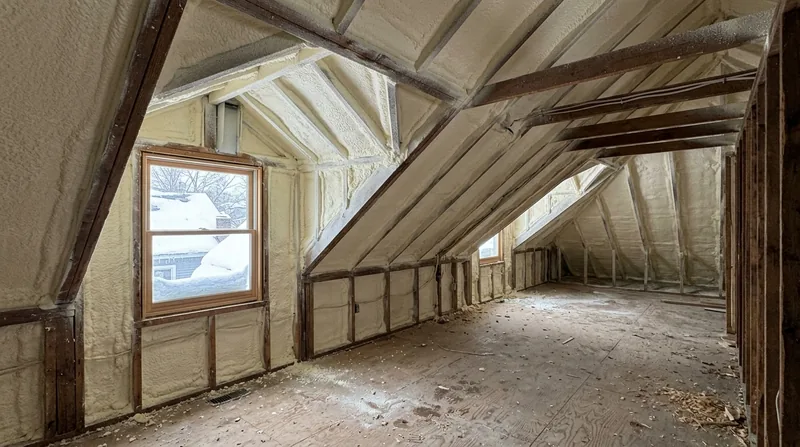




Attic spray foam insulation in Syracuse is the most effective way to stop heat loss through the roof deck and seal the balloon-frame bypasses that plague early-1900s homes in Eastwood, Westcott and Tipperary Hill. Lake-effect snow and ice dams are the signature winter problem here: warm air rises from the living space, melts snow from below, and water backs up under shingles because the attic above is still cold and uninsulated. Spray foam applied directly to the roof deck closes those gaps, keeps the attic warm enough to prevent the melt-and-freeze cycle, and stops the moisture that settles as frost or condenses on old framing. Whether you own a two-and-a-half-story frame house with balloon walls, a mid-century cape with a finished attic room, or a newer ranch in Clay or Cicero, the physics is the same: seal the ceiling plane, control the vapor, and the heating bill drops. We've been doing this work across Onondaga County since 2012, and we know exactly where Syracuse homes leak.
Why Attic Spray Foam Insulation Matters in Cold, Snowy Syracuse
Syracuse sits in IECC climate zone 5A, a heating-dominated region where winter is long and the heating bill is the single largest energy cost for most homeowners. The problem isn't just that old insulation settles and loses R-value over decades; it's that attic air bypasses, gaps around balloon-frame walls, unblocked rim joists, and open chases, let warm, moist indoor air escape directly into the cold attic space. That moisture condenses or freezes on cold framing, and the heat that escapes melts snow from below the shingles, causing ice dams that back water into the house. Spray foam seals all of that in one pass.
- Stops ice dams by keeping the roof deck warm and preventing melt-and-refreeze cycles.
- Seals balloon-frame bypasses and unfinished attic walls that fiberglass insulation cannot reach.
- Controls moisture by creating a continuous vapor barrier on the warm side of the attic.
- Reduces heating load, which is the dominant energy cost in Central New York winters.
- Adds structural rigidity to the roof deck and improves overall home durability.
These benefits are why sealed attics have become the standard retrofit in Syracuse and across the Northeast, especially in homes built before 1980 when air sealing was not a design priority.
Local example: A 1920s two-story frame house in Eastwood with an unfinished attic and balloon walls in the walls loses heat through three invisible paths: the open rim joist where the first floor sits on the foundation, the balloon-frame cavities that run from basement to attic, and the uninsulated attic space itself. Spray foam seals the rim joist, fills the wall cavities from the attic side, and covers the roof deck. The heating bill drops by 20 to 30 percent, and ice dams stop forming.
For technical guidance on attic ventilation and thermal barriers in your specific address, consult the City of Syracuse Building Department, which oversees energy code compliance and permits for all attic work in the city.
How We Spray Foam Your Attic: The Process in Syracuse
Attic spray foam insulation starts with a thorough walkthrough to identify all the air bypasses, measure the attic space, and determine whether you need a sealed roof deck (most common in Syracuse) or a sealed attic floor with ventilation above. We then set up mechanical ventilation to manage off-gassing during the cure, protect any electrical wiring or fixtures that must be kept clear of foam, and apply the foam in controlled passes to achieve the specified R-value and thickness. The job typically takes one day for an average-sized attic, and the home is safe to re-enter 24 to 48 hours after the work is complete.
- We walk the attic, identify all air leaks, and take measurements to estimate board feet and confirm R-value targets.
- We set up mechanical ventilation and temporary air handling to manage VOC emissions during cure.
- We protect electrical fixtures, wiring, and any recessed lights that sit in the attic space.
- We apply spray foam in controlled passes, starting at the lowest point and working toward the ridge, maintaining proper drum temperature and mixing ratio throughout.
- We allow 24 to 48 hours for full cure before re-entry, and we provide clear guidance on that timeline in writing.
- We conduct a final walkthrough to confirm coverage, measure final thickness, and document R-value achieved.
This step-by-step approach ensures that the foam bonds properly to the roof deck, seals all bypasses, and meets the R-value and thermal barrier requirements of the building code in force at your address.
Real example: A 1,400-square-foot attic in Liverpool with an existing fiberglass blanket and several open rim joists takes about 6 hours to spray to R-38 closed cell. We remove nothing; we spray directly over the old insulation. The homeowner vacates for two days, the job is done by Friday, and they're back in the house by Sunday with a sealed attic and no ice dams the following winter.
For details on how we approach insulation removal and replacement when old material must come out first, visit our removal page.
Attic Spray Foam Methods: Sealed Roof Deck vs. Sealed Floor
| Method | Description | Best For |
|---|---|---|
| Sealed Roof Deck (Closed Cell) | Spray foam applied directly to the underside of the roof sheathing, creating an unvented attic. High R-value per inch, excellent vapor barrier, stops ice dams. | Most Syracuse homes, especially those with ice dam history or finished attic rooms. Typical R-38 to R-49. |
| Sealed Attic Floor (Open or Closed Cell) | Spray foam applied to the ceiling plane (top of the joists), leaving the attic space vented. Lower cost than roof deck spray, but requires soffit and ridge vents to work. | Unfinished attics with good roof ventilation already in place. Not recommended if ice dams are the primary problem. |
| Closed Cell Spray Foam | Two-pound density foam with R-6 to R-7 per inch. Closed cells create a vapor retarder, provide structural stiffness, and resist moisture. | Sealed roof decks, attics with moisture concerns, and homes where air sealing is the priority. Standard choice in Syracuse. |
| Open Cell Spray Foam | Half-pound density foam with R-3.5 per inch. Lower cost, better sound dampening, but requires a separate vapor retarder and is less effective at air sealing in cold climates. | Sound control in finished attic rooms, or budget-conscious top-ups over existing insulation when the attic is already fairly tight. |
Most Syracuse homes benefit from a sealed roof deck with closed cell foam. Ice dams are the dominant failure mode here, and closed cell is the most reliable way to prevent them. If you have an unfinished attic with no ice dam history, open cell or even blown-in fiberglass may be the right answer, and we'll tell you plainly if that's the case. For more detail on closed and open cell, see our pages on closed cell spray foam and open cell spray foam.
Attic Spray Foam Insulation Cost in Syracuse: What to Expect
Attic spray foam insulation in Syracuse typically starts at $1.50 to $2.50 per square foot of attic floor area, depending on the R-value target, the type of foam, and the complexity of the attic layout. A 1,200-square-foot attic sealed to R-38 with closed cell foam runs between $1,800 and $3,000 before any removal of existing insulation. If old insulation must be hauled out first, add $0.50 to $1.00 per square foot for removal labor and disposal. Rim joists, wall bypasses, and other air sealing around the attic can add another $500 to $2,000 depending on the scope.
The biggest variables are attic size, accessibility (tight knee walls and cathedral ceilings cost more), whether you need removal, and the R-value you're aiming for. A sealed roof deck to R-49 costs more than R-38, and a home with balloon-frame walls that need injection foam in the cavities will run higher than a simple roof-deck spray. The best way to know your actual cost is to get a free written estimate with R-value and thickness specified. We'll walk the attic, measure it, and give you a firm number with no surprises.
Cost example: A 1,500-square-foot attic in Camillus with R-38 closed cell, no removal needed, and straightforward roof geometry runs about $2,250 to $3,000. The same attic with removal of old fiberglass and injection foam in the balloon-frame walls runs $3,500 to $4,500. A 900-square-foot finished attic room in Fayetteville with cathedral ceilings and tight knee walls runs $1,500 to $2,200 because the spray pattern is more complex and access is tighter.
For a detailed pricing breakdown and to see what's included at each price point, visit our pricing page. Remember that the cheapest estimate is rarely the best one: look for a contractor who provides written R-value and thickness specs, shows proof of insurance, and gives you a clear timeline and re-entry window in writing.
Attic Spray Foam Insulation Near Me: What Syracuse Homeowners Should Know When Hiring
Hiring a spray foam contractor is not the same as hiring a general contractor. The work is chemical and technical, and a low-ball estimate with no R-value spec, no insurance verification, and a promise to re-enter the house immediately is a red flag. Before you call anyone, understand what permits apply in your city (Syracuse, Liverpool, Camillus and other municipalities have different rules), whether your HOA has any restrictions on exterior or attic work, and what the building code requires for thermal barriers and ventilation at your address. Then ask any contractor you're considering these questions.
- Request a written estimate that includes the R-value target, the thickness in inches, the foam type (closed or open cell), and the total board feet to be sprayed.
- Ask for proof of insurance and verify the coverage limits with the insurance company directly, not just by looking at a certificate.
- Get at least two or three estimates so you can compare scope, price, and the quality of the explanation you receive.
- Ask whether mechanical ventilation will be running during the spray and cure, and confirm the re-entry timeline in writing (24 to 48 hours is standard).
- Find out whether the contractor pulls the permit or whether you will, and confirm that they understand the specific code requirements for your address.
- Check references from recent jobs in your neighborhood, and ask those homeowners whether they had any issues with odor, timing, or cleanup after the work was done.
- Avoid any contractor who promises mold remediation, rodent exclusion, or crawl space encapsulation as part of the attic job; those are separate trades and should be referred, not bundled.
A reputable local contractor will answer all of these questions clearly, provide references, and never pressure you into a same-day decision. If you're ready to move forward, call us at (315) 907-4259 for a free estimate. We'll walk your attic, explain what we find, and give you a written price with no obligation to book.
Attic Spray Foam Insulation in Syracuse: Pricing Guide
| Service | Price | Details |
|---|---|---|
| Sealed Roof Deck, Closed Cell, R-38 to R-49 | Starting at $1.50/sq ft | Most common job in Syracuse. Cost depends on attic size, access, and whether existing insulation must be removed first. |
| Sealed Attic Floor, Open Cell, R-30 to R-38 | Starting at $0.95/sq ft | Lower cost option for unfinished attics with good ventilation. Not recommended if ice dams are the primary concern. |
| Removal of Old Insulation (fiberglass, blown-in, cellulose) | Starting at $0.50/sq ft | Labor and disposal. Add this to the spray cost if old material must come out before foam goes in. |
| Wall Cavity Injection Foam (balloon frame, retrofit) | Starting at $3.00/sq ft | Drilling and injecting foam into closed wall cavities. Price varies by cavity depth, wall height, and number of holes required. |
| Rim Joist and Band Joist Air Sealing | Starting at $800 | Typical scope for a single-family home basement perimeter. Exact cost depends on linear feet of joist and accessibility. |
| Free Written Estimate | No charge | Response within 24 hours. Includes R-value, thickness, foam type, and total board feet. Call (315) 907-4259. |
Indicative pricing, the exact cost depends on square footage, finish, and site access. Free personalized estimate within 24h at (315) 907-4259.


