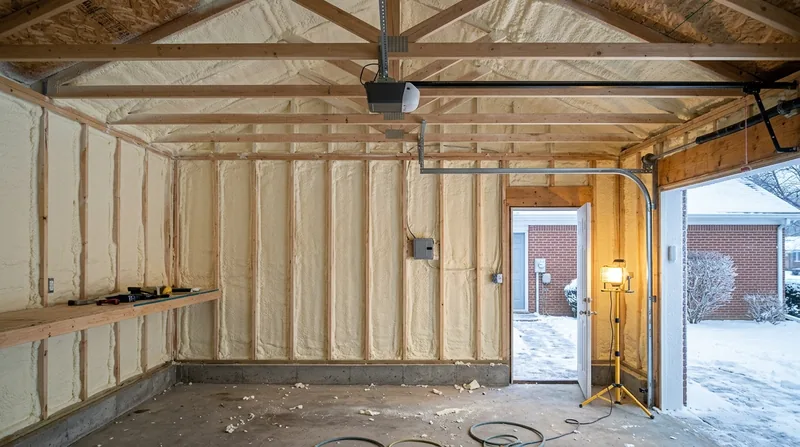




Garage spray foam insulation in Syracuse turns an unheated, drafty workspace into a usable room through a Central New York winter. Detached and attached garages across Onondaga County lose heat through uninsulated walls and ceilings, leaving pipes vulnerable to freezing and making any winter work impossible without space heaters running constantly. Spray foam seals the entire envelope, stops air leakage at the rim joists and band board, and gives you a climate-controlled garage without the heating bill of conditioning an open shell. In a climate zone 5A heating-dominated market like ours, where lake-effect snow and subzero temperatures dominate from November through March, a properly insulated garage is not a luxury, it is the difference between a functional workshop and a frozen storage shed. We spray closed cell or open cell foam into garage walls, ceilings, and rim joists to cut drafts, protect plumbing, and deliver the R-value your Syracuse address needs.
Why Garage Spray Foam Insulation Matters in Syracuse's Cold Climate
Syracuse winters are relentless. Uninsulated garage walls and ceilings allow warm air to escape through convection and air leakage, while cold outdoor air infiltrates through gaps around doors, windows, and rim joists. The result is a garage that never holds heat, pipes that freeze, and a workshop that is unusable from December through March unless you run a space heater continuously. Spray foam insulation stops this cycle by creating an airtight thermal barrier that keeps conditioned air inside and cold air outside.
- Protects water lines and drains from freezing when the garage is unheated or partially heated.
- Reduces heat loss through walls and ceilings by up to 80 percent compared to an uninsulated garage.
- Stops cold air infiltration through rim joists, band boards, and sill plates where the garage meets the foundation.
- Allows you to heat the garage to a usable temperature without running the furnace constantly.
- Improves safety by reducing condensation and frost buildup on metal tools and equipment.
In neighborhoods like Eastwood, Liverpool, and Camillus, where attached and detached garages are standard on mid-century capes and ranches, spray foam insulation is the fastest way to reclaim usable space and protect your home's infrastructure.
Key info: Syracuse's heating season runs October through April, with average winter lows below 20 degrees and lake-effect snow adding moisture to the air. Uninsulated garage walls and ceilings allow warm interior air to rise and escape through the roof, while moisture condenses on cold metal surfaces. Spray foam stops both the heat loss and the moisture problem.
For guidance on permits and building code requirements for garage insulation in your city, contact your local building department or visit the New York State Department of Environmental Conservation Energy Code page.
How We Insulate Garages in Syracuse: Our Process
Garage spray foam insulation begins with a site visit to measure the space, identify air leakage points, and determine whether closed cell or open cell foam is the right choice for your use. We inspect rim joists, band boards, the ceiling plane, and wall cavities. Once we understand your garage layout and heating plans, we provide a written estimate with R-value and thickness specifications. On the job day, we set up containment, spray the foam in controlled passes to achieve the target thickness, allow proper cure time with mechanical ventilation, and leave the space sealed and ready for finishing or immediate use according to code.
- We conduct a free on-site estimate and measure the garage walls, ceiling, and rim joists.
- We specify the R-value and thickness required for your garage and heating scenario in a written estimate.
- We set up containment and mechanical ventilation before spraying to control odor and ensure safe cure.
- We spray closed cell or open cell foam in multiple passes, maintaining proper drum temperature and mix ratio.
- We allow the foam to cure fully (typically 24 to 48 hours) before you re-enter the space.
- We inspect the finished work for coverage, thickness, and any voids that need spot-filling.
A typical attached garage in De Witt or North Syracuse takes one to two days from start to finish, depending on size and whether we are also sealing rim joists or removing old insulation first.
Example: A 400-square-foot detached garage in Syracuse with 8-foot walls and an uninsulated ceiling needs closed cell foam at 2 inches on the walls (R-13) and 3 inches on the ceiling (R-19) to meet code and handle the heating load. We also foam the band joist and rim board where the garage meets the foundation. Total thickness is specified in the estimate before we spray.
Learn more about closed cell spray foam and open cell spray foam to understand which product fits your garage and budget.
Garage Insulation Methods and Options
| Method | Description | Best For |
|---|---|---|
| Closed Cell Foam | Dense, rigid foam with R-7 per inch. Stops air and moisture infiltration. Requires mechanical ventilation during cure. | Garages in climate zone 5A where moisture control and high R-value in thin space are critical. |
| Open Cell Foam | Lighter, more flexible foam with R-3.5 per inch. Less expensive. Allows vapor transmission. Still requires ventilation during spray. | Budget-conscious garage insulation where thicker foam is acceptable and moisture is not a primary concern. |
| Walls Only | Foam applied to garage walls and rim joists, leaving the ceiling uninsulated. Reduces cost and is useful if the ceiling is already finished or inaccessible. | Attached garages where the ceiling is shared with heated living space or where budget is limited. |
| Complete Envelope | Foam applied to walls, ceiling, rim joists, and band boards. Creates a fully sealed, insulated garage. | Detached garages and workshops in Syracuse where year-round climate control and maximum energy efficiency are the goal. |
Each method is chosen based on your garage layout, heating plans, and budget. We provide a written estimate with R-value and thickness for whichever approach makes sense for your address and use.
Garage Spray Foam Insulation Cost in Syracuse: What to Expect
Garage spray foam insulation in Syracuse typically starts at $1,200 for a small attached garage with walls and rim joists only. A larger detached garage with full ceiling and wall coverage runs between $2,000 and $4,500, depending on size, foam type, and whether existing insulation must be removed first. The biggest cost drivers are the square footage of walls and ceiling, the R-value required by code, whether you choose closed cell or open cell foam, and access (attic crawl spaces and tight rim joists cost more to spray than open walls). If your garage has old insulation that must be removed, add the cost of removal and disposal to the estimate.
Getting two or three written estimates from local contractors is the best way to understand pricing for your specific job. Each estimate should specify the R-value, foam thickness, and total board feet of foam. Estimates that omit these details or quote only a per-square-foot price are red flags. We provide a written estimate with R-value and thickness specifications at no charge and with no obligation to book.
For a detailed breakdown of pricing across all our services and to understand what factors affect cost, visit our pricing page.
What to Look for When Hiring a Spray Foam Insulation Contractor Near Syracuse
Hiring the right spray foam contractor is critical because improper installation, wrong foam-to-hardener ratio, inadequate thickness, missing mechanical ventilation during cure, or immediate re-entry before the foam has cured, leads to poor performance, odor complaints, and wasted money. The spray foam trade includes both local, accountable shops and rig-and-run crews from out of state who spray a job in an afternoon and disappear when the smell will not go away. A good contractor is reachable, provides a written estimate with R-value and thickness, uses mechanical ventilation during cure, and stands behind the work with a clear warranty.
- Verify that the contractor is fully insured and ask for a certificate of insurance naming you as an additional insured.
- Request a written estimate that specifies the R-value per inch, the target thickness, and the total board feet of foam to be sprayed.
- Ask whether the contractor uses mechanical ventilation during cure and what the re-entry window is (typically 24 to 48 hours).
- Check references from recent garage or attic jobs in Syracuse, De Witt, or Liverpool to confirm quality and responsiveness.
- Confirm that the contractor understands your local building code and will help you navigate permitting if required by your city.
- Avoid estimates with no R-value, no thickness, or prices far below market, which often signal inexperience or corner-cutting.
If you have questions about spray foam insulation or would like a free estimate for your garage, contact us at (315) 907-4259. We are fully insured, provide written estimates with R-value and thickness specifications, and have been serving Syracuse and Onondaga County since 2012.
Garage Spray Foam Insulation in Syracuse: Pricing Guide
| Service | Price | Details |
|---|---|---|
| Small attached garage (walls and rim joists only) | Starting at $1,200 | Typically 200 to 300 square feet of wall and rim joist area with closed cell or open cell foam |
| Medium detached garage (walls and ceiling) | Starting at $2,000 | 400 to 500 square feet with full wall and ceiling coverage; size and foam type determine final cost |
| Large detached garage or workshop (complete envelope) | Starting at $3,500 | 600+ square feet with walls, ceiling, rim joists, and band board; includes highest R-value specification |
| Insulation removal and replacement | On estimate | Removal of old fiberglass or cellulose adds labor and disposal cost; quoted separately with the insulation job |
| Travel and estimate | Free | No charge for on-site measurement and written estimate; response within 24 hours at (315) 907-4259 |
Indicative pricing, the exact cost depends on square footage, finish, and site access. Free personalized estimate within 24h at (315) 907-4259.


