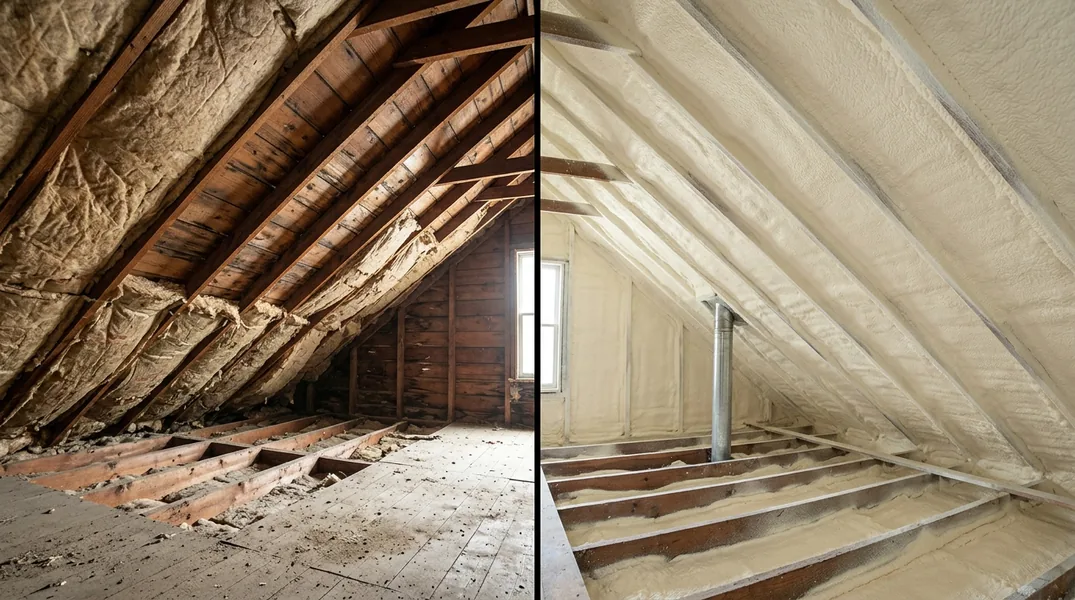
The Real Difference Between Air Sealing and Spray Foam
When homeowners in Syracuse start thinking about attic insulation, they often face a confusing choice: should they hire someone to air seal their attic first, or jump straight to spray foam? The honest answer is that these are not competing solutions. They work differently, and which one you need depends on your current situation and goals.
Air sealing means finding and closing gaps, cracks, and holes where conditioned air escapes and outside air leaks in. Think of it as patching holes in a bucket. Spray foam, by contrast, is an insulation material that fills cavities, resists air movement, and provides thermal resistance (R-value). It's more like replacing the bucket entirely. Many homes benefit from both, but understanding the distinction helps you make a smarter investment in your home's comfort and energy efficiency.
Understanding Spray Foam Insulation R-Value Per Inch and Why It Matters
One of the most important numbers in insulation is R-value, which measures how well a material resists heat flow. The higher the R-value, the better the insulation performs. When it comes to Attic Spray Foam Insulation, the R-value per inch varies significantly based on the type of foam used. Closed Cell Spray Foam Insulation typically delivers R-6 to R-7 per inch, making it one of the most efficient insulation materials available. Open Cell Spray Foam Insulation, by contrast, provides R-3.5 to R-3.6 per inch but costs less and allows some moisture vapor transmission.
For homeowners deciding how thick spray foam should be, understanding R-value per inch is critical. If you need to achieve an R-value of R-38 (a common target for attic insulation in colder climates), closed cell foam requires only 5.5 to 6.5 inches, while open cell foam needs roughly 11 inches. This difference affects both material costs and the space available in your attic. In Syracuse, where winters are cold and heating costs matter, closed cell foam often makes more financial sense over time despite higher upfront costs.
R-Value Requirements by State: What Syracuse Homeowners Need to Know
New York State does not mandate a specific attic R-value in residential building codes, but the International Energy Conservation Code (IECC), which New York adopts with local amendments, recommends R-38 to R-60 for attic insulation depending on your climate zone. Syracuse falls in a cold climate zone where higher R-values are cost-effective and strongly recommended by energy professionals. Meeting or exceeding R-38 in your attic can reduce heating costs significantly, especially in homes built before modern insulation standards.
Many homeowners mistakenly think they need to follow a single national standard, but regional climate and local utility costs drive the real recommendation. In central New York, where winter temperatures drop well below freezing for months, underinsulating your attic wastes money every heating season. If you're unsure whether your current attic meets recommended standards, a professional energy audit can show you exactly where you stand. This information often qualifies you for state or federal incentives.
Insulation Tax Credits and Rebates: How to Offset Your Investment
One reason homeowners hesitate to invest in quality insulation is cost, but federal and state incentives can significantly reduce your out-of-pocket expense. The federal Energy Star tax credit allows homeowners to claim up to 30 percent of qualifying insulation improvements, capped at $3,200 total per year. This applies to both spray foam and traditional insulation if it meets energy performance standards. New York State also offers rebate programs through utility companies and the Department of State, though availability and amounts vary by location and program year.
To qualify for an insulation tax credit, your materials and installation typically must meet specific performance criteria, and you'll need documentation from your contractor. This is why working with an experienced local company like Syracuse Spray Foam Insulation matters. We understand which products qualify for incentives and can help you navigate the paperwork. Some homeowners save $1,000 to $2,000 or more after combining federal tax credits with state rebates, making premium insulation options far more affordable than they initially appear.
How Thick Should Spray Foam Be? A Practical Guide for Syracuse Attics
Determining how thick spray foam should be depends on your target R-value, the type of foam, and your attic's structure. As mentioned earlier, closed cell foam at R-6.5 per inch needs only 5.5 to 6.5 inches to reach R-38, while open cell foam requires roughly 11 inches. However, thickness is not just about hitting a number. Your attic's rafter depth, ventilation requirements, and any existing insulation all factor into the final recommendation. In older De Witt and Solvay homes, attic spaces can be tight, making closed cell foam's superior efficiency a practical advantage.
Another consideration is whether to apply foam directly to the roof deck or to the attic floor. Roof deck spray foam creates a conditioned attic space, which is excellent for finished attic rooms or HVAC equipment, but costs more. Floor-level application is more common for unfinished attics and is typically more cost-effective. The right thickness and placement strategy depends on your specific home. We recommend scheduling a free estimate so a professional can assess your attic and recommend the optimal approach.
Making Your Decision: Air Sealing, Spray Foam, or Both
So which should you choose? If your attic has significant air leaks (you can often feel drafts or see daylight), air sealing should be your first step. It's less expensive, addresses immediate comfort issues, and prevents energy waste. However, air sealing alone does not add much R-value. If your attic is already well-sealed but under-insulated, spray foam is the right solution. If you have both problems, a combined approach delivers the best results and often qualifies for higher rebates and tax credits.
The best way forward is a professional energy assessment. A qualified contractor can identify air leaks, measure existing insulation, calculate your R-value deficit, and recommend a cost-effective plan tailored to your home. Syracuse Spray Foam Insulation serves homeowners throughout Westvale and the surrounding region with honest advice and quality installation. Whether you need Wall & Injection Foam Insulation or attic foam, we'll help you understand your options, explore available rebates and tax credits, and invest wisely in your home's comfort and efficiency. Call us at (315) 907-4259 or request a free estimate today to get started.
Looking for a professional spray foam insulation contractor in Syracuse? Syracuse Spray Foam Insulation responds fast for all your spray foam insulation needs.
Get a Free Quote