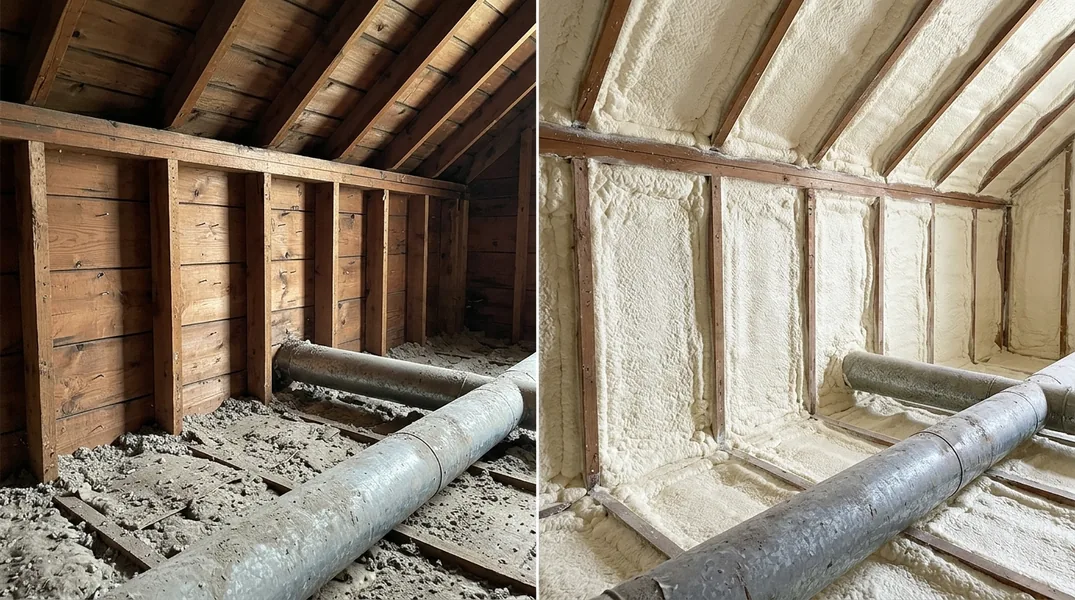
Understanding Flattened Attic Insulation in Liverpool and Camillus
Homeowners throughout Liverpool, Camillus, and the greater Syracuse area frequently discover that their attic insulation has lost its effectiveness over time. This happens more often than you might think, especially in older homes where traditional blown-in or fiberglass batts were installed decades ago. The culprit is simple: gravity, moisture, and settling cause these materials to compress and flatten, reducing their insulating value significantly.
When insulation flattens, it loses the air pockets that trap heat and keep your home comfortable. A compressed R-value of R-19 might perform like R-10 or worse, meaning your heating and cooling systems work overtime to maintain temperature. This directly translates to higher energy bills and reduced comfort, particularly during our cold upstate New York winters and humid summers. If you've noticed your energy costs climbing or uneven temperatures throughout your home, flattened attic insulation is likely the culprit.
Spray Foam vs Blown In Insulation: Which Lasts Longer?
Attic Spray Foam Insulation and blown-in insulation represent two fundamentally different approaches to attic protection. Blown-in insulation, typically made from cellulose, fiberglass, or mineral wool, is installed by blowing loose material into your attic space. While this method is less expensive upfront, it suffers from a critical weakness: it settles and compacts over time, especially in the climate we experience here in the Syracuse region. Within 5 to 10 years, you may see 15 to 20 percent settling, which erodes your R-value and energy efficiency.
Spray foam, by contrast, expands to fill every cavity and crack, then hardens into a rigid or semi-rigid form that does not settle or compress. This permanent expansion means your insulation maintains its original R-value for decades. Closed Cell Spray Foam Insulation offers an R-value of approximately 6.5 to 7 per inch, while Open Cell Spray Foam Insulation provides around 3.5 to 4 per inch. Both options outperform blown-in materials over the long term because they do not flatten or shift after installation.
Spray Foam vs Fiberglass: Superior Air Sealing Advantages
Fiberglass batts have been the standard attic insulation choice for generations, and they remain affordable and easy to install. However, fiberglass insulation has a fundamental limitation: it only insulates where it is placed. Air can still infiltrate around edges, seams, and gaps between batts, allowing conditioned air to escape and outside air to enter. In a typical attic, these uncontrolled air leaks can account for 20 to 30 percent of your home's total heat loss during winter months.
Spray foam addresses this problem comprehensively. When applied properly, spray foam seals every gap, crack, and penetration in your attic simultaneously. It adheres to wood framing, pipes, electrical wiring, and ductwork, creating an air-tight thermal envelope that fiberglass cannot match. This dual benefit of insulation plus air sealing means your heating and cooling system operates more efficiently, your home feels more comfortable, and your energy bills drop noticeably. For homes in Liverpool and Camillus where winter temperatures plummet, this air-sealing advantage is invaluable.
Best Insulation for Attic: Why Professionals Choose Spray Foam
When asked what constitutes the best insulation for attic applications, energy auditors and building scientists increasingly point to spray foam. The reasons are straightforward: superior R-value per inch, permanent effectiveness, moisture resistance, and comprehensive air sealing in a single application. Unlike blown-in insulation, which may require topping up every 10 to 15 years, or fiberglass batts, which deteriorate and allow air leakage, spray foam provides a one-time solution that lasts the life of your home.
Spray foam also excels in challenging attic spaces where traditional insulation falls short. If your attic has cathedral ceilings, irregular framing, exposed pipes, or wiring bundles, spray foam conforms to every surface and obstacle. Blown-in insulation tends to settle away from these problem areas, leaving them under-insulated. Additionally, spray foam's closed-cell variants provide a vapor barrier, protecting your attic from moisture intrusion, condensation, and mold growth. In the humid climate of upstate New York, this moisture protection is a critical advantage that blown-in cellulose or fiberglass cannot provide.
Spray Foam vs Cellulose: Long-Term Performance and Durability
Cellulose insulation is an eco-friendly choice made from recycled paper, and it appeals to environmentally conscious homeowners. It offers decent R-value (approximately 3.6 per inch) and is less expensive than spray foam. However, cellulose has several drawbacks that limit its long-term effectiveness. It settles more aggressively than fiberglass, sometimes losing 10 to 20 percent of its R-value within the first few years. It also absorbs moisture readily, which can lead to mold growth and structural damage in humid climates like ours in the Syracuse area.
Spray foam, while a petroleum-based product, offers superior durability and environmental benefit through energy savings. A home insulated with spray foam uses significantly less energy for heating and cooling over its lifetime, offsetting its initial manufacturing impact many times over. The permanent nature of spray foam means you will not need to replace or add insulation in 10 or 15 years, whereas cellulose installations typically require maintenance and eventual replacement. For homeowners seeking the best long-term value and performance, spray foam consistently outperforms cellulose in real-world conditions.
Attic Spray Foam Insulation Cost in Syracuse: What to Budget
The cost of attic spray foam insulation varies based on several factors, including attic size, accessibility, existing insulation removal, and which type of spray foam you choose. Open cell spray foam typically costs less per square foot than closed cell, ranging from $1.50 to $2.50 per board foot installed. Closed cell spray foam, which offers higher R-value and superior moisture protection, generally runs $2.50 to $4.00 per board foot. For a typical 1,200-square-foot attic, expect to invest between $3,000 and $8,000 depending on your choices and site conditions.
While this initial investment is higher than blown-in insulation or fiberglass, the long-term savings justify the cost. Most homeowners see energy bill reductions of 15 to 30 percent after spray foam installation, with payback periods of 5 to 10 years. After that, you enjoy pure savings and improved comfort for decades. To understand the exact pricing for your specific attic in Liverpool, Camillus, or anywhere in the Syracuse region, contact Syracuse Spray Foam Insulation at (315) 907-4259 or request a free estimate. Our team will assess your attic, discuss your goals, and provide a transparent quote with no hidden fees.
Looking for a professional spray foam insulation contractor in Syracuse? Syracuse Spray Foam Insulation responds fast for all your spray foam insulation needs.
Get a Free Quote